 PHARAOH.SE
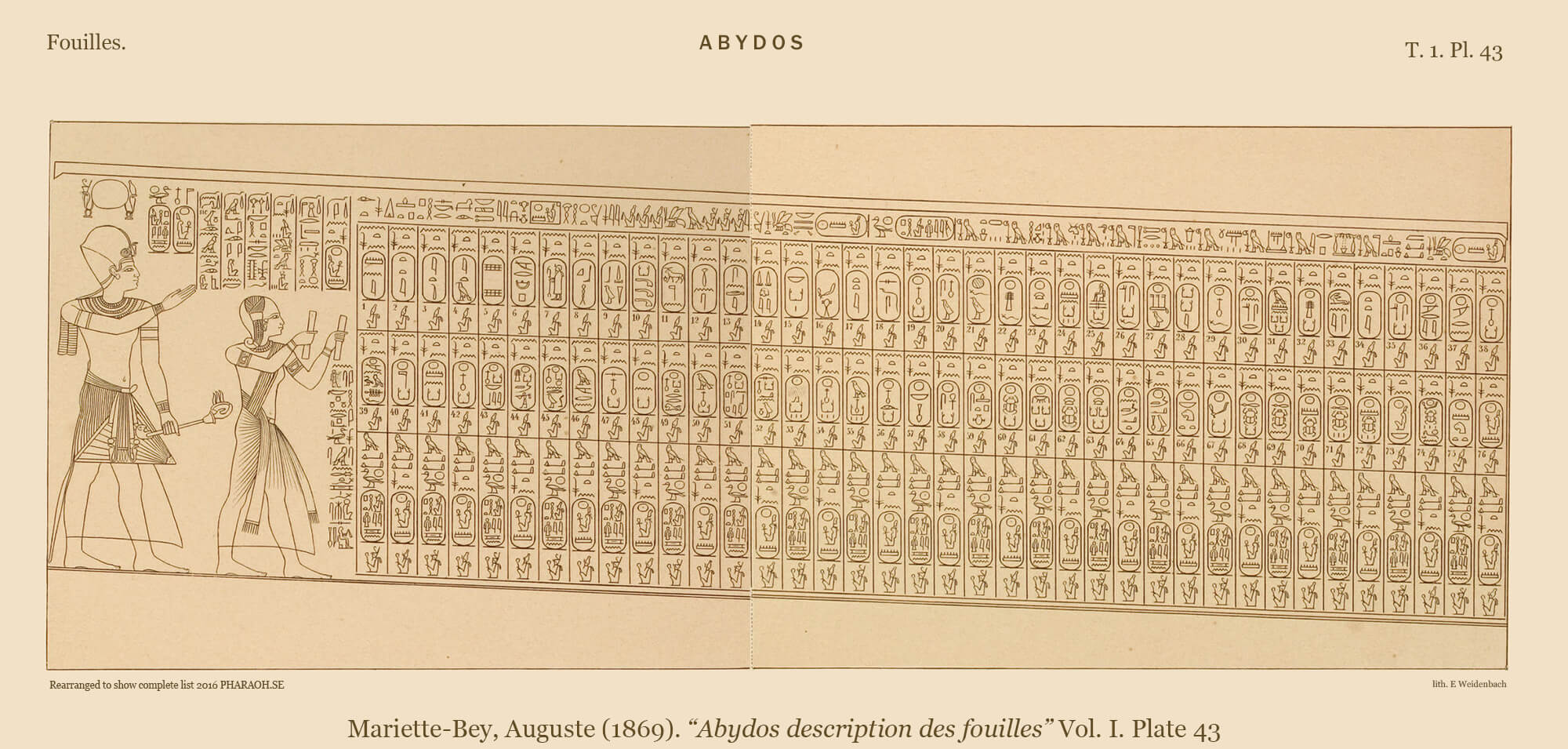
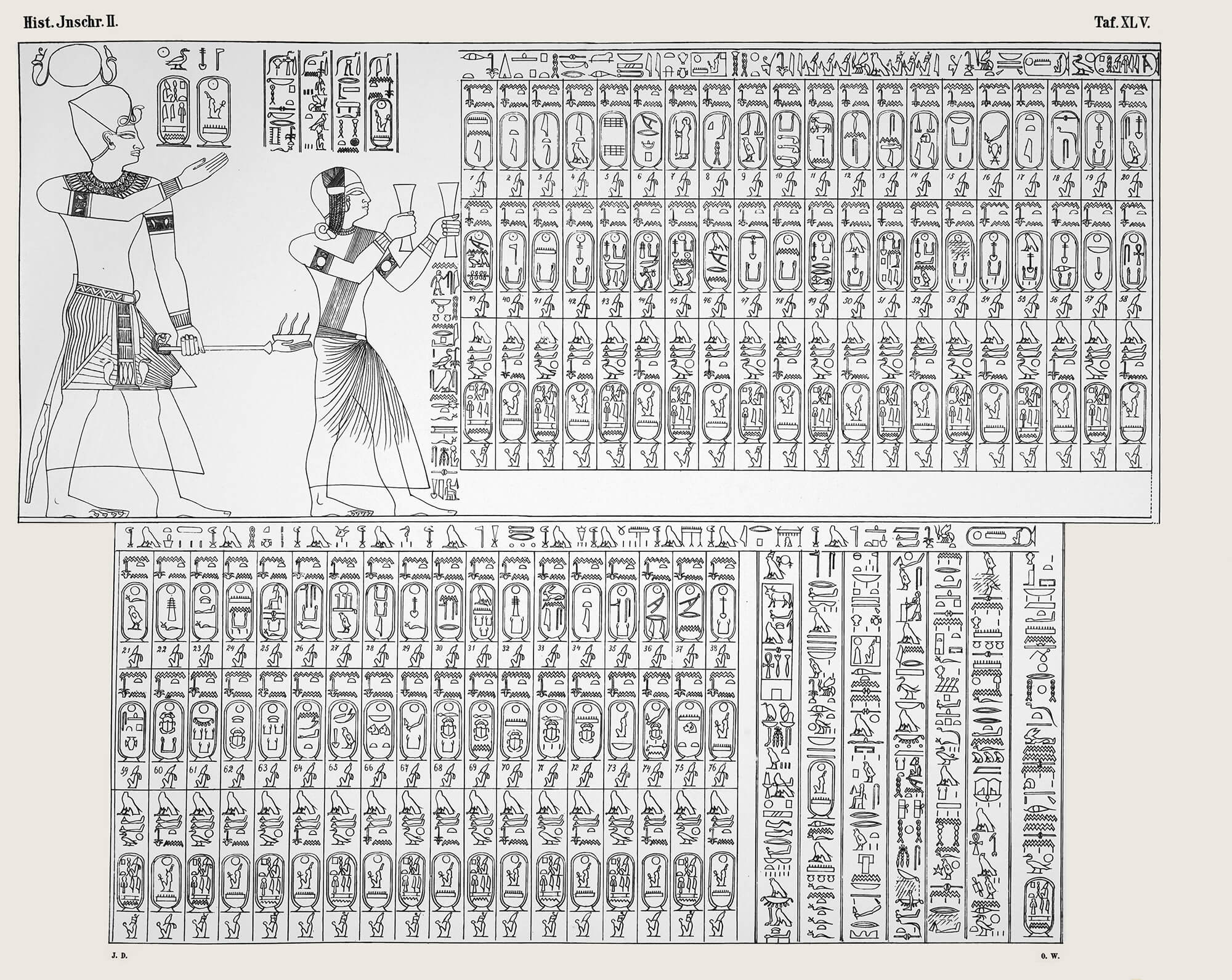
The Abydos King List, also known as the Abydos king list is an inscription in raised relief containing the cartouches of 76 pharaohs of ancient Egypt.
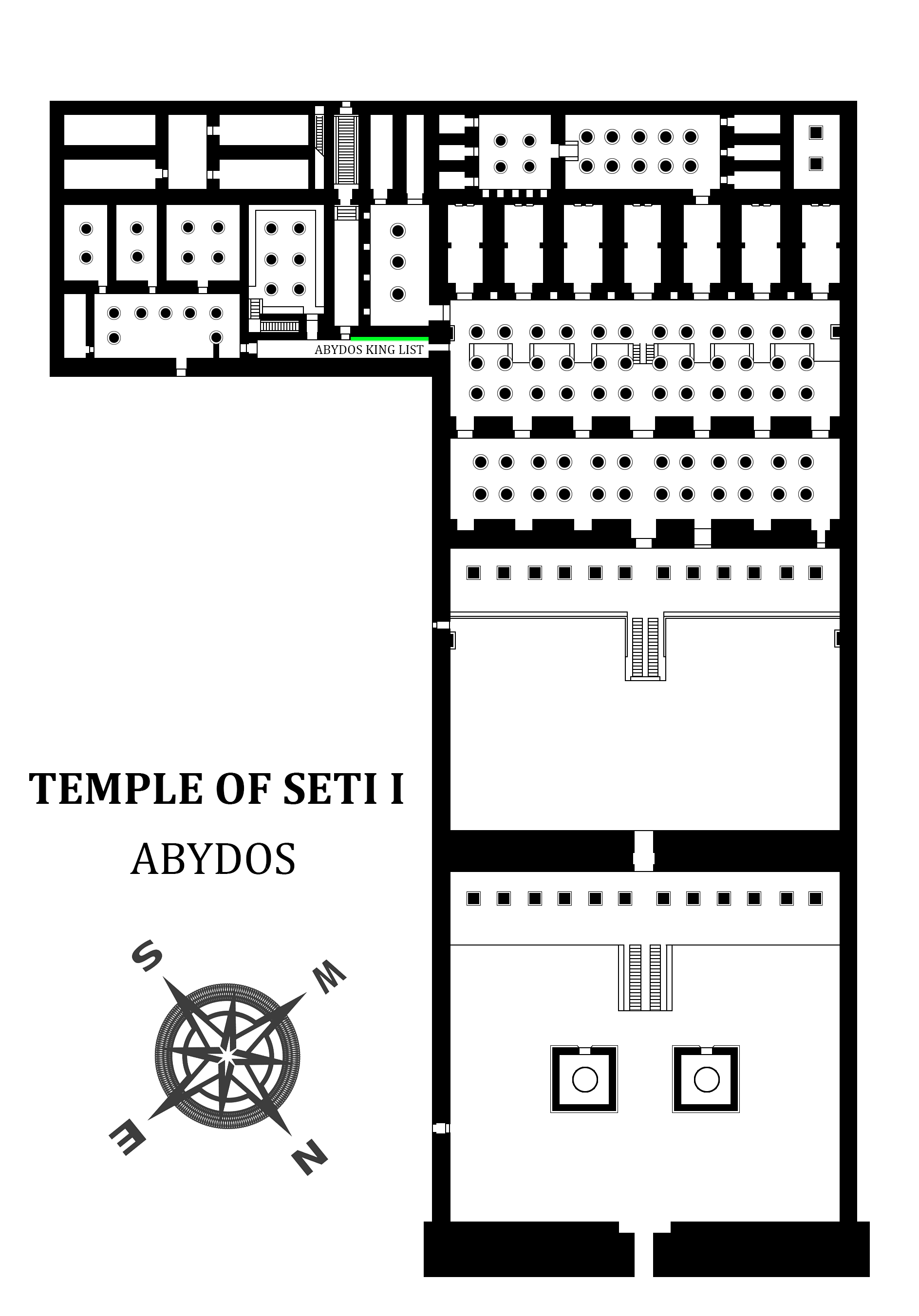
The inscription of kings is found in the Mortuary Temple of Seti I at Abydos in Egypt, on the right wall of the passage coming from the second Hypostyle Hall, referred to as the Gallery of the Ancestors. Due to Seti I's untimely death, the construction of the temple was finished by his son, Ramesses II. For much of Egypt's history, Abydos was a pilgrimage center for the worship of Osiris, and the main purpose of the hidden temple, the Osireion, was to transform the deceased king into the god Osiris.
Strabo visited Abydos in the first century BC and mentions the temple but also a well, hidden somewhere deep down below the main temple.
“Above this city [Ptolemais] lies Abydus, where the Memnonium, a royal building, which is a remarkable structure built of solid stone, and of the same workmanship as that which I ascribed to the Labyrinth; and also a well which lies at a great depth, so that one descends to it down vaulted galleries made of monoliths of surpassing size and workmanship.”Strabo, Geography, XVII.1.42.
Auguste Mariette's excavation and clearing of earth and debris during 1859-1863, revelaed the temple after millennia of being buried by sand. There was no trace of Strabo’s well, which would remain undiscovered until 1914, but it was an important part of the legend of Osiris. Ironically, much of the debris cleared by Mariette was dumped on top of the Osireion.
“Ten years ago, the temple of Seti was buried and almost entirely hidden beneath the sands. The sand had also slipped inside through collapsed roofs, and only a few walls remained above ground and were copied by Lepsius (LD III, 138). The work completed, it was clear that Strabo’s well could not have escaped our attention.”Mariette, 1869. Abydos I, p. 7 (9).
The king list of Seti I in the main temple was part of a procession where the spirits of the ancestors were invoked. The kings were celebrated ancestors of Seti I, and is by large a chronological list. The names show an orderly progression of legitimate rulers of Memphis. The omitted kings include those whose rule over the Two Lands was politically or religiously biased in some way; for example, those who did not rule from Memphis. Only kings that were worthy of admiration and respect were selected, the Amarna pharaohs were deliberately omitted, as were kings from the Second Intermediate Period.
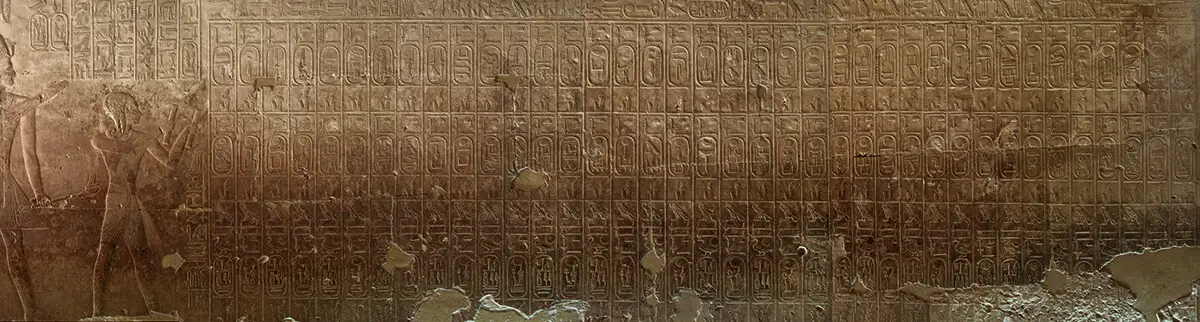 Image credit: Wikimedia Commons
The inscription depicts Seti I on the left wearing the blue crown, holding a censer in one hand and gesturing towards the right with the other. A text runs in six short vertical columns before him, which is the speech given by Seti I.
Words spoken by King Menmaatra. Bringing the god to his repast and laying out an offering for the Dual kings. Hail to you, O Ptah Sokar South-of-His Wall! Come, that I may make for you the things that Horus did for his father Osiris.
In front of the King, a young prince Ramesses II is shown holding papyrus-rolls to read from. The accompanying text is a single column just before him:
Recitation of praise by the Hereditary Prince; the eldest of his body, his beloved son, Ramesses, justified.
Then a symmetrical list of cartouches, consisting of three rows of 38 cartouches. The names of ancestral kings occupy the first two rows, for a total of 76 kings. Each cartouche of a is preceded by “for king...” and followed by a seated king determinative. Importantly, above the names of the kings, a text runs the entire length of the 38 columns, which is the beginning offering formula for the deceased kings, read from the scroll by Prince Ramesses:
Making “an Offering which the king gives” (for) Ptah-Sokar-Osiris, Lord of the Shetayet-shrine, residing in the Temple of Menmaatra. Laying out offerings for the Dual Kings, by the Dual King, Lord of the Two Lands, Menmaatra, Son of Ra, Seti-Merenptah: a 1000 of bread, a 1000 of beer, a 1000 of oxen, a 1000 of fowl, a 1000 of incense, a 1000 of unguent, a 1000 of fine linen and cloth, a 1000 of wine, a 1000 of sacred offerings, by gift of King Menmaatra.
Below the ancestral kings, a third row, the Throne and Birth names of Seti I alternate, with 19 of each. These are preceded by the “By gift of ...” and then alternates between “King Menmaatra” followed by a seated king wearing the white crown of Upper Egypt, and “Son of Ra, Seti-Merenptah” followed by a seated king wearing the red crown of Lower Egypt. This part concludes the recitation by Ramesses for each king. This would make the repeating offering recitation for each of the 76 kings:
A 1000 bread, a 1000 beer, a 1000 oxen, a 1000 fowl, a 1000 incense, a 1000 unguent, a 1000 fine linen and cloth, a 1000 wine, a 1000 sacred offerings for [King's Name], by the gift of [Son of Ra, Seti-Merenptah/King Menmaatra].
The Abydos King List should not to be confused with the Abydos Table, or Tablet, which is a king list of Ramesses II discovered at the remains of his nearby temple, which imitated his father's king list.