
Pharaoh.SEPHARAOH.SE

Hieratic

Hieratic writing was a cursive script of simplified and connected characters used in ancient Egypt. It could be written quickly on papyrus, making it practical and very suitable for everyday use, unlike hieroglyphics, which took a long time to write. It was mainly used for religious, administrative and literary texts.
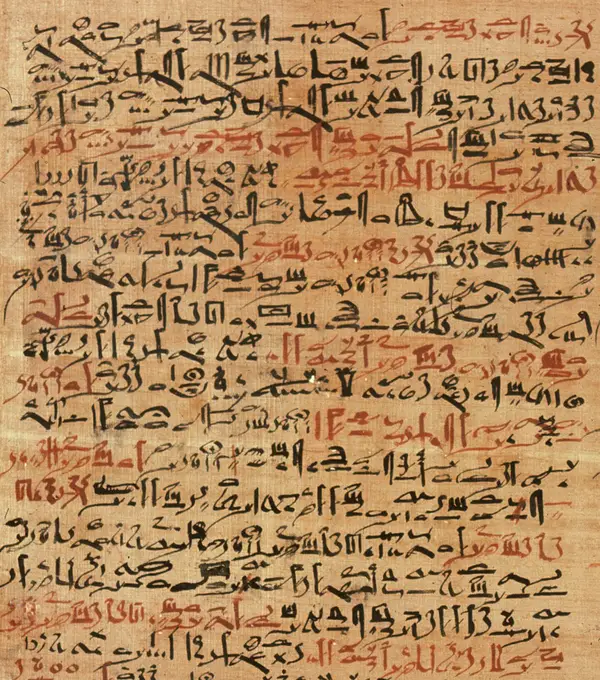
Scribes were highly esteemed and educated professionals who played a pivotal role in administrative, religious and intellectual activities. They were responsible for all writing-related tasks, including administrative duties, record-keeping, drafting legal documents and correspondence, and producing sacred texts. They were trained in hieratic writing and hieroglyphics, which were both complex and difficult to master. The scribe would carefully copy the text from the original source onto the prepared papyrus. This process required precision and attention to detail to avoid errors. The scribe would follow a predetermined layout and formatting, replicating the organization of the original text. This might involve the use of columns, headings, and other structural elements.

In some cases, especially for religious or important texts, the scribe might include decorative elements and illustrations. These could range from simple designs to elaborate scenes. After completing the copy, the scribe might review the text for errors. Corrections could be made directly on the papyrus, and in some cases additional notes. Once the copying and corrections were done, the papyrus sheet could be rolled into a scroll if the text was lengthy. Copies of texts were often stored in protective containers, such as cylindrical cases for scrolls. These containers helped preserve the papyrus from environmental factors, such as humidity and pests. The production of multiple copies involved manual reproduction by scribes. Each copy was produced individually, and skilled scribes were valued for their ability to create accurate and aesthetically pleasing duplicates. In some cases, workshops specialized in the reproduction of texts. Multiple scribes could collaborate in such workshops to produce copies more efficiently. Copies of texts were distributed to various locations, including temples, libraries, and private collections. This dissemination contributed to the preservation and accessibility of important literary, religious, and administrative texts.

Copying manuscripts by hand is a meticulous task, and scribes could make unintentional mistakes. These errors might include misspelling words, omitting or duplicating lines, or misinterpreting the original text. Over time, papyri deteriorate due to exposure to the elements, pests, or simple aging. This can lead to the loss or distortion of text, making it difficult to accurately interpret the original content. In some cases, individuals may intentionally alter or forge a manuscript to serve a particular agenda or to create a more valuable document. This could involve adding or removing content, changing the wording, or modifying details to suit the forger's purposes.

Papyri are also vulnerable to damage from water or fire, which can result in the destruction or alteration of the text. Water damage may cause ink to run or pages to stick together, while fire damage can char or consume portions of the manuscript. The quality of ink used can affect its longevity. If the ink fades or bleeds over time, it can make the text illegible or altered.

Papyrus can be damaged by insects feeding on it, leading to the loss of content. Additionally, their excrement can stain or obscure the text. Mould and mildew can grow on papyri, especially if stored in damp conditions. This can result in the decay of the material and make the text difficult to read. Tearing, folding, or creasing pages can result in the loss of text or make it challenging to discern.

Human error is a significant factor contributing to the potential corruption of hand-written manuscripts. Scribes, who were responsible for copying texts in ancient times, were skilled individuals, but not immune to making mistakes. Some ways in which human error could lead to alterations in manuscripts:

Understanding the potential for human error is crucial for scholars engaged in textual criticism, a field that aims to reconstruct the most accurate version of a text by comparing different manuscript copies and identifying variations. This process helps researchers discern the original wording and meaning of a text despite the inevitable errors introduced by scribes throughout history.

The codex format refers to a type of book characterized by pages bound together on one side, forming a more book-like structure compared to the scroll. While the widespread adoption of the codex format occurred later, during the late Roman and early Christian periods, its roots can be traced back to antiquity.

It's important to note that the study of ancient manuscripts involves careful consideration of these potential sources of corruption. Scholars and historians use various techniques, such as textual criticism, to identify and correct errors, understand the context, and reconstruct the most accurate version of the original text. The Egyptians wrote with a brush made from the stem of a rush called Juncus maritimus, which still thrives in Egypt's saline marshes.