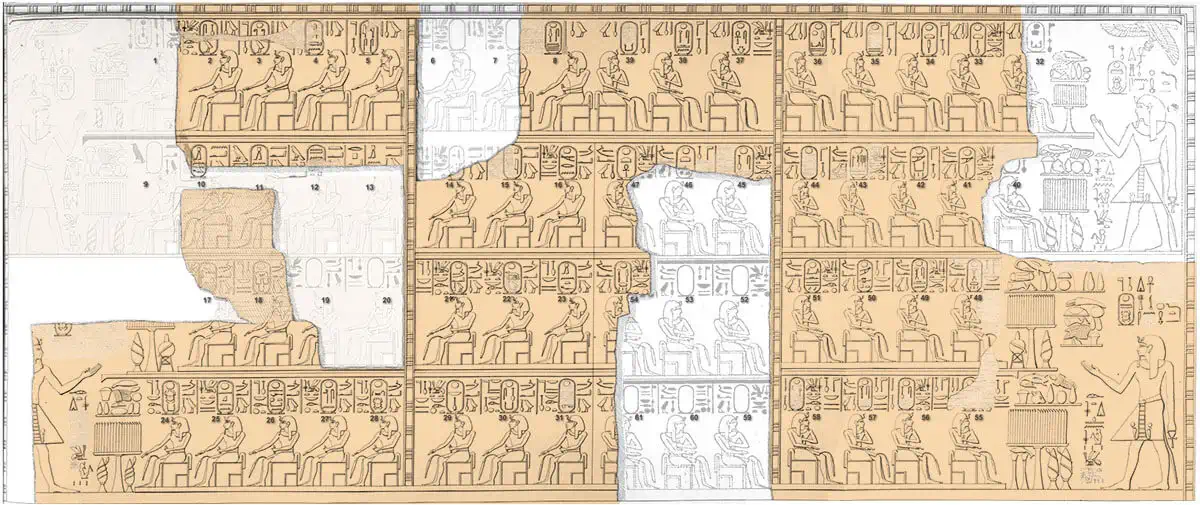
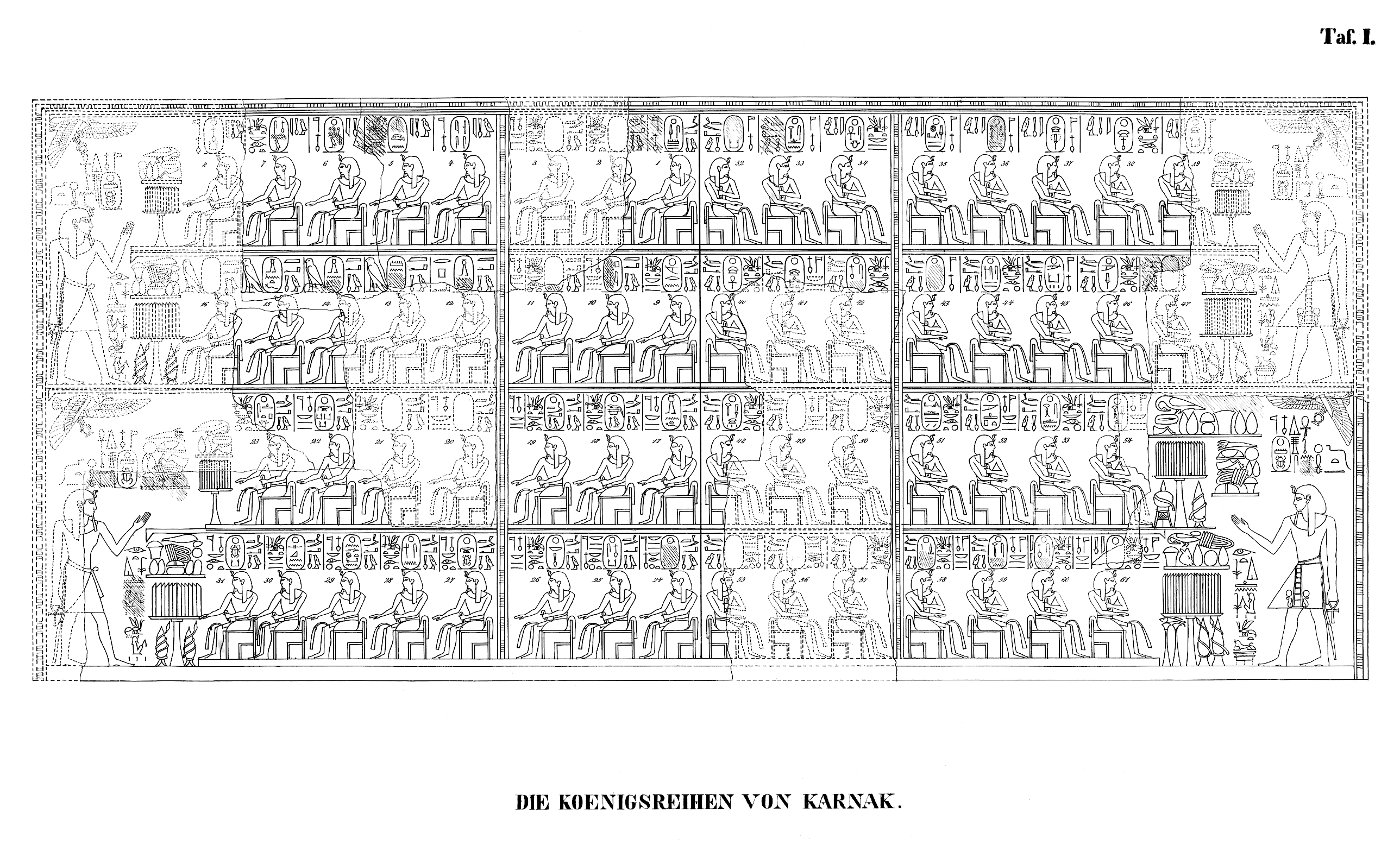
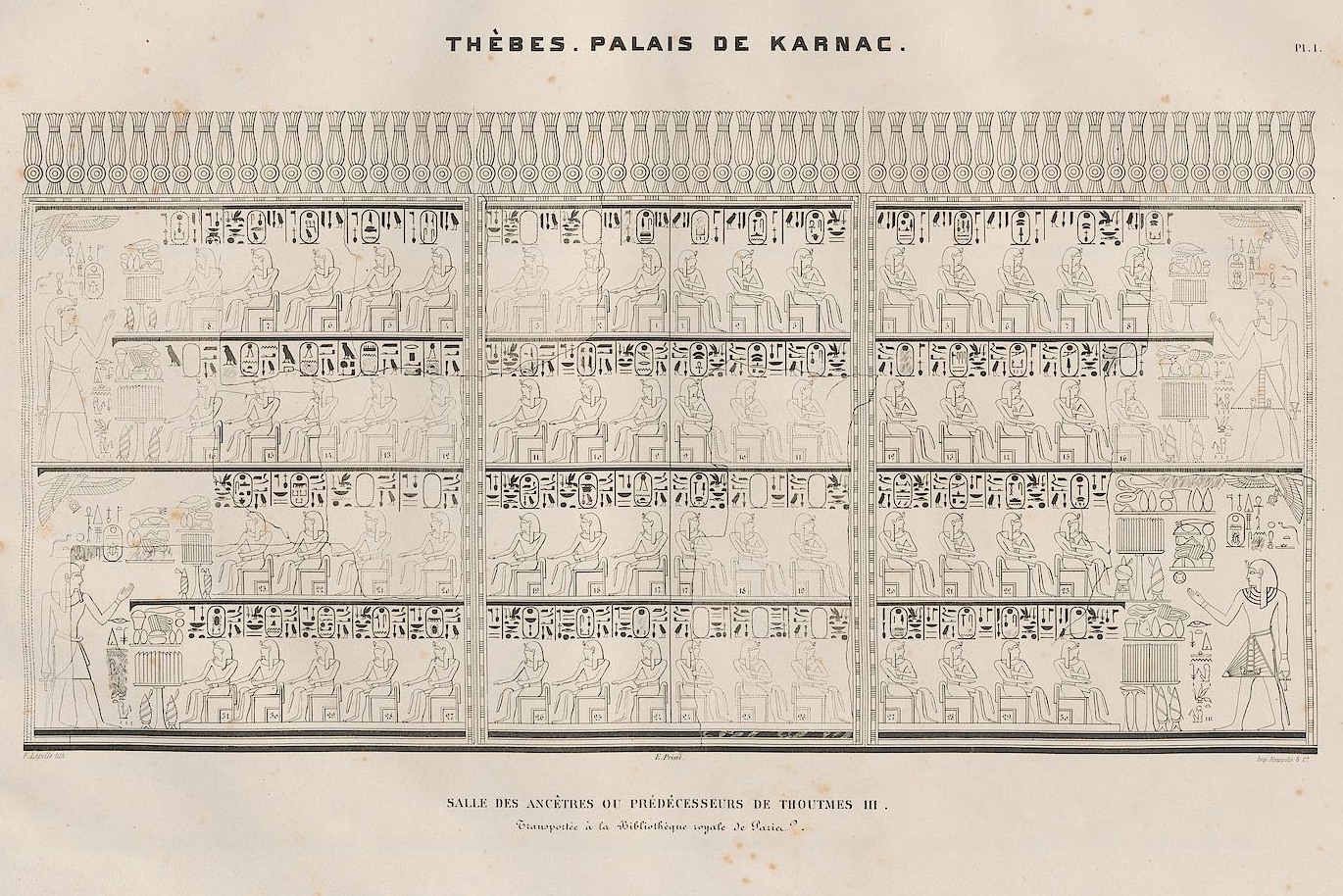
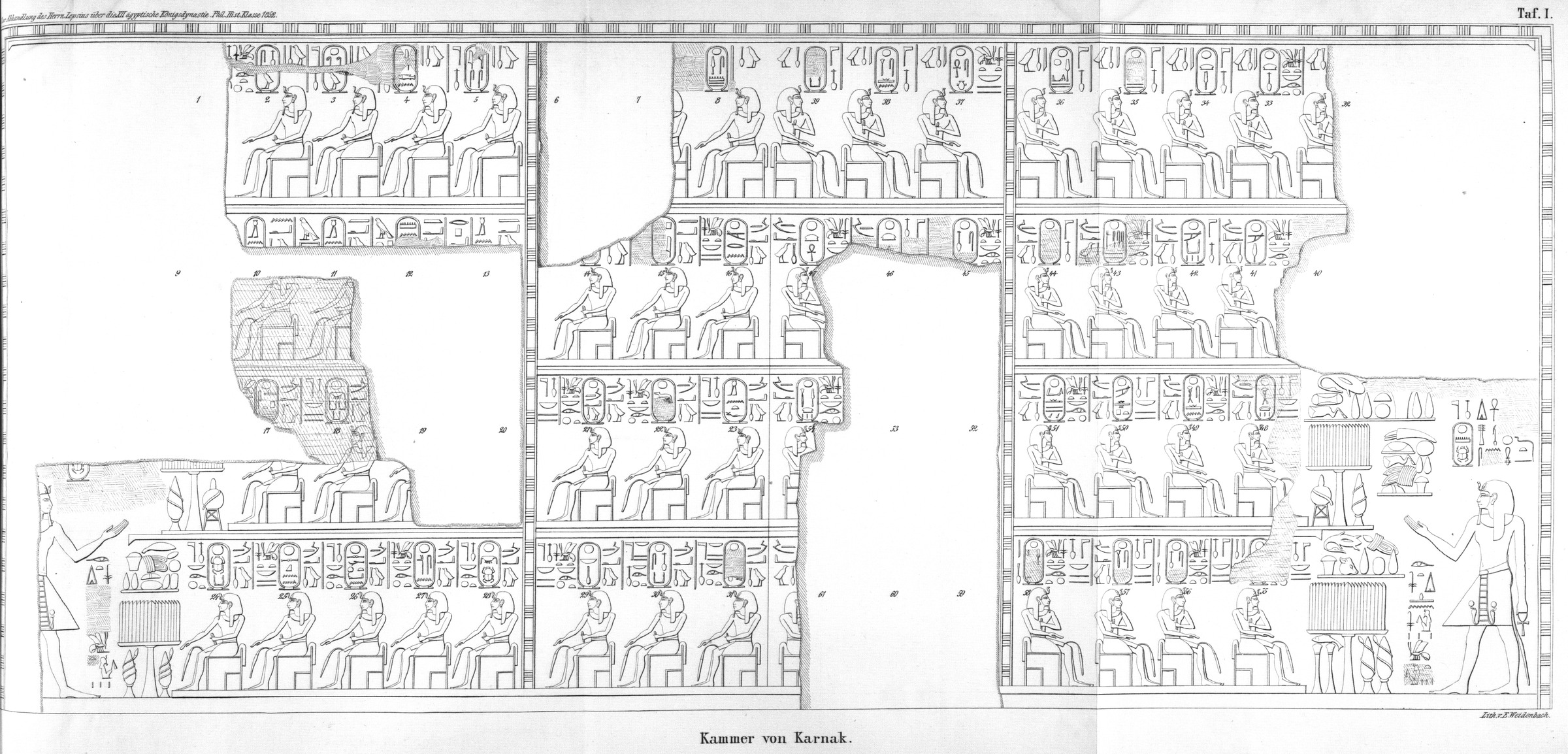
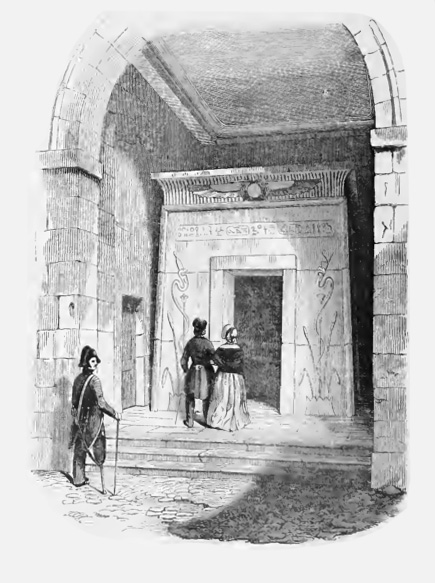
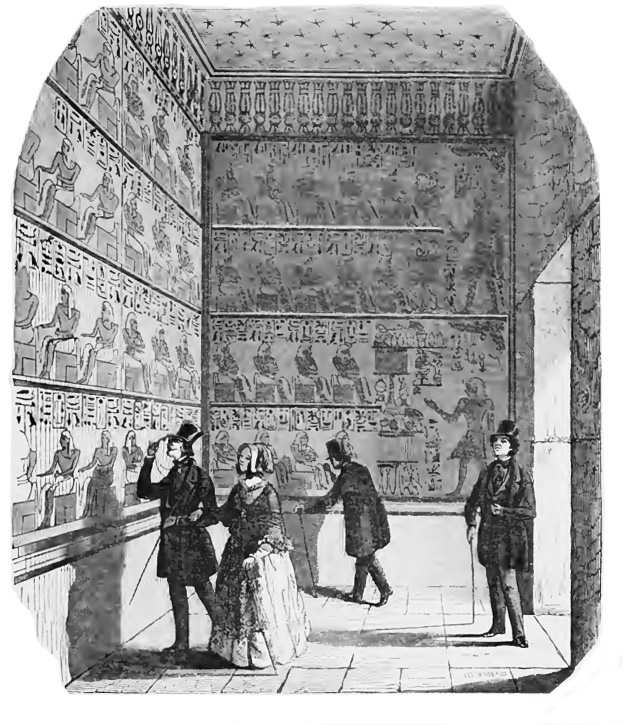
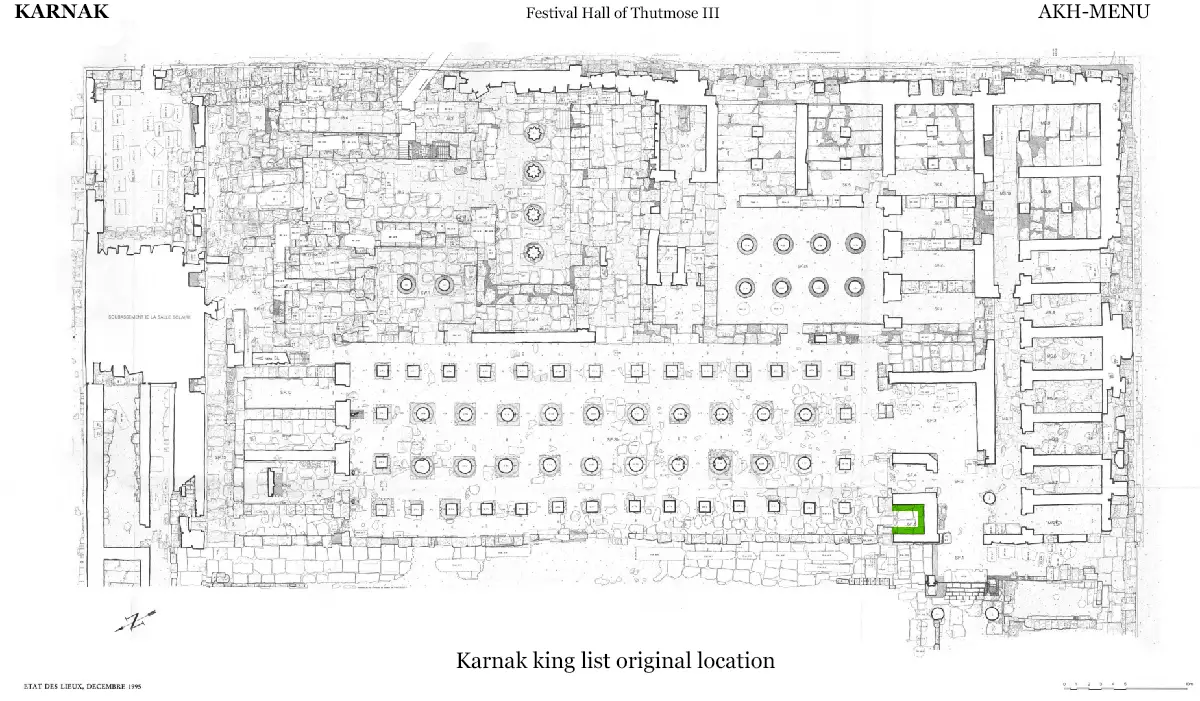
Also known as the Karnak king list, it include several kings of the First and Second Intermediate Periods, omitted by the king lists of Abydos and Saqqara. Originally located in the southwest corner of the Akh-Menu Hall of the Temple of Amun-Re at Karnak.
Created during the reign of Thutmose III, it listed sixty-one kings, only the names of thirty-nine kings are still legible, and one is not written in a cartouche. Interestingly, the names include a large number of Second Intermediate Period kings not found in the other monumental king lists.
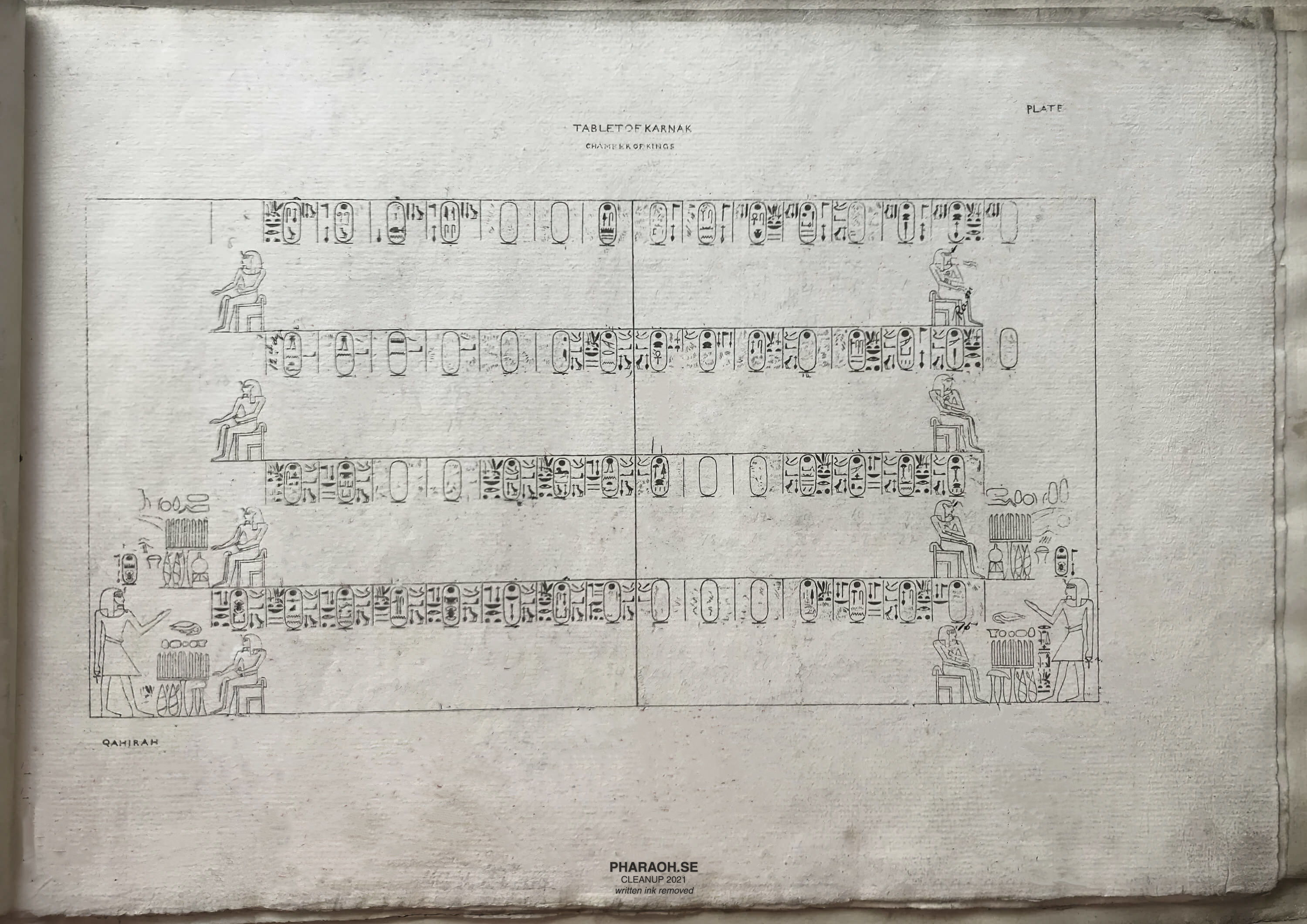
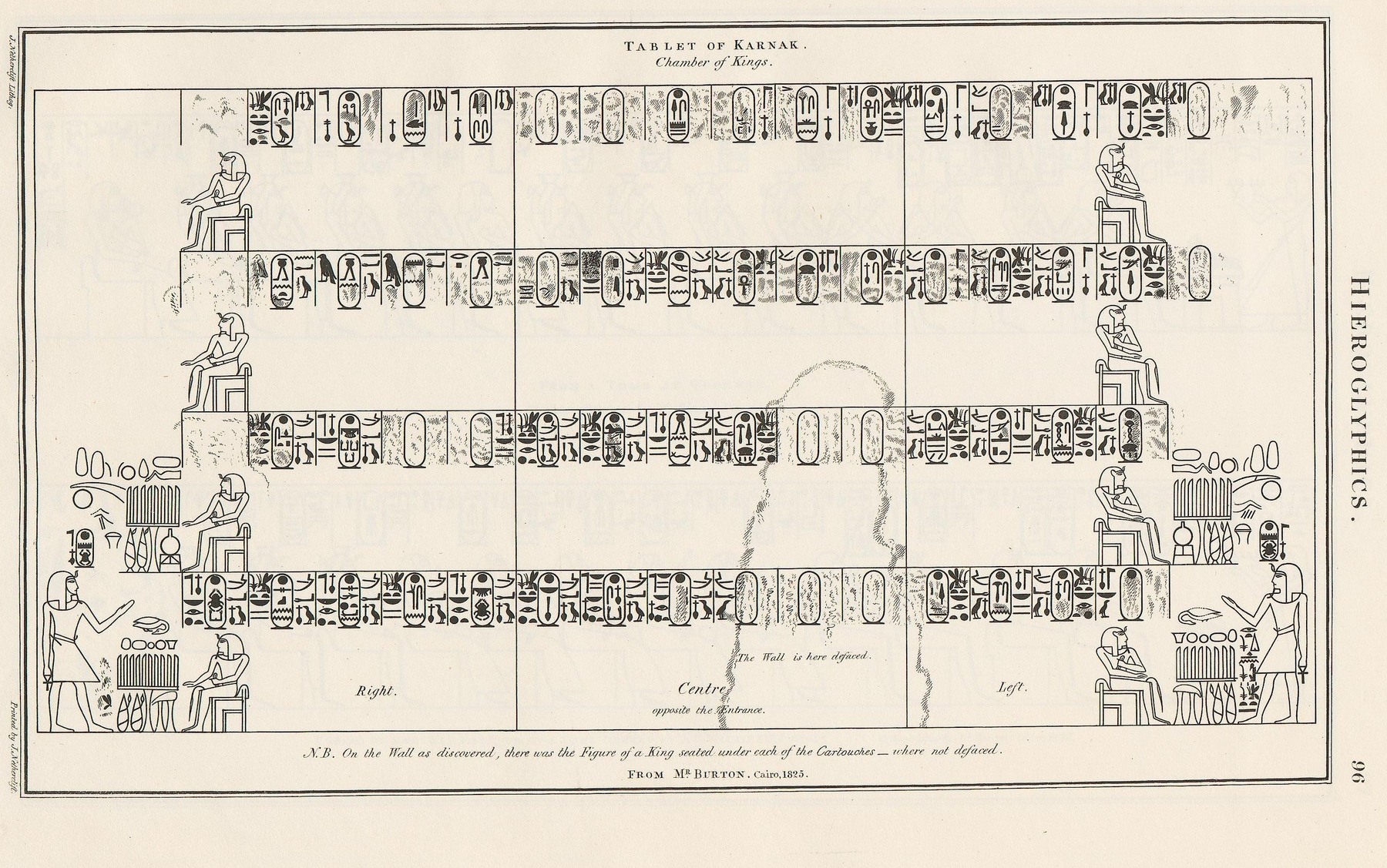
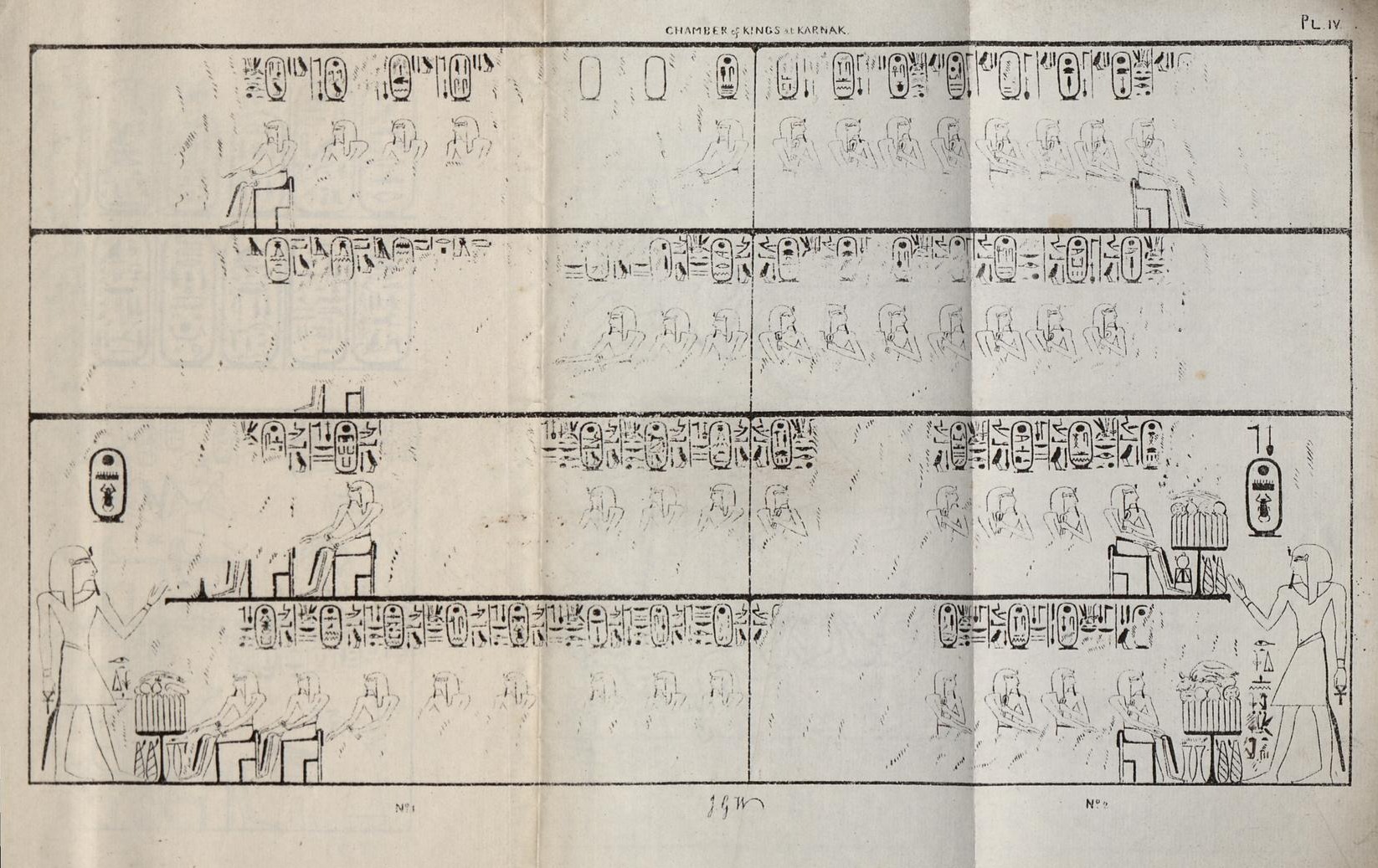
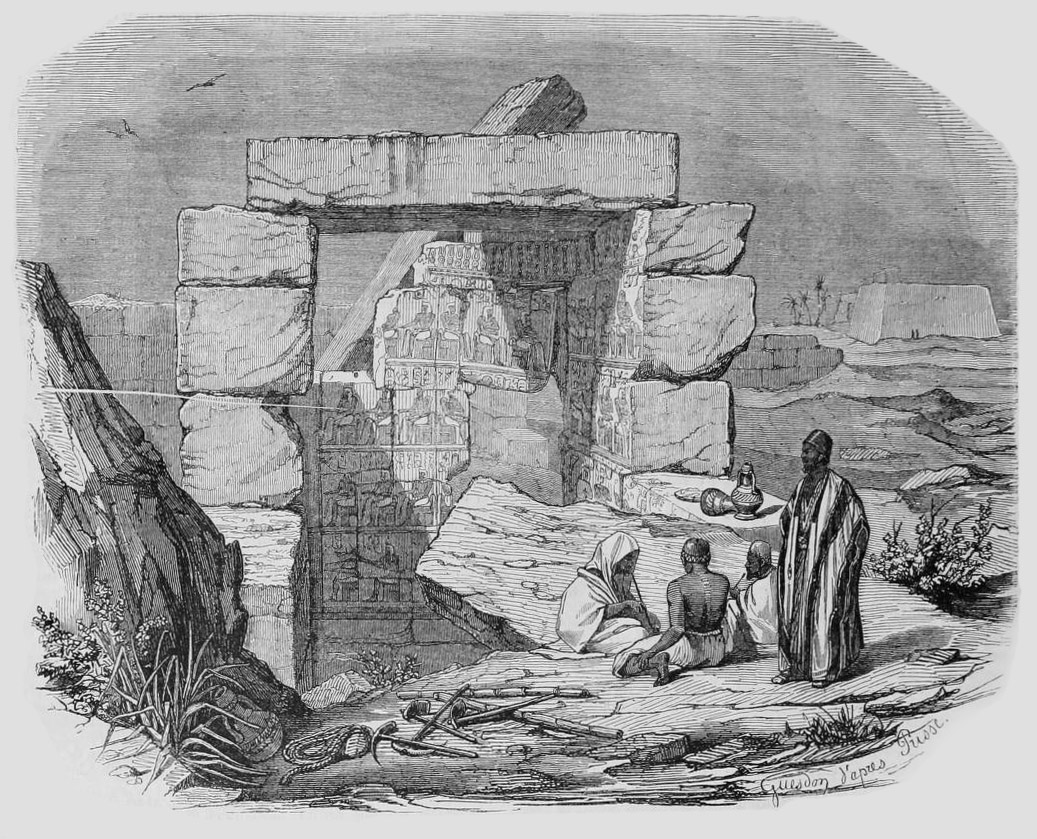
The king list was first described by James Burton in 1825, while exploring and excavating the ruins around Thebes in the early 1820s. Most likely the walls were uncovered while he was excavating the ruins, as the Napoleonic expedition did not mention or copy the scene.
During the mid-1840s, the Lepsius expedition was traveling all over Egypt, competing to purchase interesting Egyptian relics. Under the pretense of rescuing it from certain German acquisition, French archaeologist Émile Prisse d’Avennes had the king list dismantled in secret in order to secure it for France, and had it sent home to Paris in 27 boxes. The transport caused some lesser damage to a few of the stone blocks, but the painted bas-reliefs were in a good state when inspected upon arrival. Incredibly, the boxes were then left where they stood, some barely closed, in the courtyard outside the library, where they remained throughout the fall and winter. After several months of rain, wind, snow and sun, the painted reliefs were now completely denuded of paint. Quelle surprise!
Severely damaged, the blocks with the king list can be seen in the Louvre museum in Paris (Chapelle des ancêtres, Cat. no. E 13481 bis). The original site is in the Akh-menu (Heret-ib) festival hall, room SF-5 at Karnak.
The purpose of the list was to showered or celebrated "ancestors," and was not meant to be a chronological list. The seemingly arbitrary positions the pharaohs are placed in does not reflect the order of succession, and is written in the tradition of Upper Egypt, concentrating on kings of the South.
Content of the king list
Due to the poor state of the list, many of the names has been lost since its discovery. The early travellers who copied the inscriptions did so with varying accuracy.
Cartouches 38 and 57 (33, 59) record s-wꜢḏ-n-rꜤ, while 45 and 56 (42, 60) record s-nfr-[...]-rꜤ. Only one king with each of those names are known and identified. The recorded names were in all likelyhood mistakes by the scribes, as the wꜢḏ, nfr, and Ꜥnḫ signs look alike in hieratic.
The numbering system used in publications hail from the Editio princeps Auswahl, numbering the kings from the center to the edges, top to bottom. However, the kings are facing the edges, indicating that the correct way to read the scenes is from the edges toward the center, which Lepsius corrected in 1853. However the numbering from Auswahl prevail, and is included in a parenthesis.
Names in the king list

The cartouche is lost
—
—

Snoferu
s-nfr-w
The one who has been made perfect

Sahu Ra
sꜢḥw-rꜤ
Ra has endowed me

Ini
ini
Ini

Isesi
issi
Isesi
The cartouche is lost
—
—
The cartouche is lost
—
—

Sekhem Ra Semen tawy
sḫm-rꜤ smn-tꜢwi
The powerful one of Ra, who has made the Two Lands firm
The cartouche is lost
—
—

Intef
[ḥr-..] in-t.f
—

Intef
[ḥr-(s)ḥr-..] in-t.f
—

Mentuhotep
[ḥr-tp-..] mn-..
—

Hereditary Prince Intef
[iry-pꜤt ḥꜢt] in-t.f
—

Teti
titi
—

Pepy
ppy
—

Mer en Ra
mr-n-rꜤ
The one whom Ra has loved

Sehotep ib Ra
s-ḥtp-ib-rꜤ
He who satisfies the heart of Ra

Nebu kau Ra
nbw-kꜢw-rꜤ
Golden are the souls of Ra
The cartouche is lost
—
—
The cartouche is lost
—
—

Maa kheru Ra
mꜢꜤ-ḫrw-rꜤ
The righteous one of Ra

Sobek neferu Ra
sbk-nfrw-rꜤ
The perfect one of Sobek and Ra

Intef
in-t.f
—

Kheper ka Ra
ḫpr-kꜢ-rꜤ
The manifestation of the ka of Ra

Seqen en Ra
sḳni.n-rꜤ
The one whom Ra has made brave

Senakht en Ra
snḳt.n-rꜤ
The one whom Ra has made victorious

Seuser en Ra
swsr.n-rꜤ
The one whom Ra has made strong

Nub kheper Ra
nbw-ḫpr-rꜤ
The golden one is the manifestation of Ra

Neb hapet Ra
nb-ḥꜢpt-rꜤ
The possessor of the rudder of Ra

Snefer ka Ra
s-nfr-kꜢ-rꜤ
The one whom the ka of Ra has sustained
Unreadable traces
—
Traces of an unreadable name

Khakara
ḫꜤ-kꜢ-rꜤ
The Ka's of Ra have appeared

Kha nefer Ra
ḫꜤ-nfr-rꜤ
The appearance of the perfection of Ra

Kha sekhem Ra
ḫꜤ-sḫm-rꜤ
The appearance of the power of Ra

Sekhem Ra Snefer tawy
sḫm-rꜤ s-nfr-tꜢwi
The powerful one of Ra, who has made the Two Lands perfect

Sekhem Ra Khu tawy
sḫm-rꜤ ḫwi-tꜢwi
The powerful one of Ra is the protection of the Two Lands

Sankh ib Ra
s-Ꜥnḫ-ib-rꜤ
He who causes the heart of Ra to live

Sewadj en Ra
swꜢḏ.n-rꜤ
He who is made to flourish by Ra

..ka Ra
..-kꜢ-(rꜤ)
—
The cartouche is lost
—
—

Mer sekhem Ra
mr-sḫm-rꜤ
The beloved one of the power of Ra

Mer kau Ra
mr-kꜢw-rꜤ
Beloved of the ka's of Ra

Sekhem Ra Seuser tawy
sḫm-rꜤ swsr-tꜢwi
The powerful one of Ra, who has strengthened the Two Lands

Unreadable traces
..-rꜤ
Only traces of Ra-sign remain

Se nefer ib Ra
s-nfr-ib-rꜤ
The one whom Ra’s heart has made perfect

Kha hotep Ra
ḫꜤ-ḥtp-rꜤ
The appearance of the peace of Ra

Kha ankh Ra
ḫꜤ-Ꜥnḫ-rꜤ
The living appearance of Ra
![<small>[Sekhem]</small> Ra Wah khau](/svg/kc/48.svg)
[Sekhem] Ra Wah khau
[sḫm]-rꜤ wꜢḥ-ḫꜤw
The <small>[powerful]</small> one of Ra is enduring of appearances

Sewah en Ra
swꜢḥ.n-rꜤ
The one whom Ra has made enduring

Mer hotep Ra
mr-ḥtp-rꜤ
The one whom the peace of Ra has loved

Khu tawy Ra
ḫw-tꜢwi-rꜤ
Ra protects the Two Lands
The cartouche is lost
—
—
The cartouche is lost
—
—

Sekhem Ra Wadj khau
sḫm-rꜤ wꜢḏ-ḫꜤw
The powerful one of Ra is flourishing of appearances

Unreadable traces
..-rꜤ
Only traces of Ra-sign remain

Senefer..ra
s-nfr-..-rꜤ
Whom the ... of Ra has made perfect

Sewadj..ra
s-wꜢḏ-..-rꜤ
The one who ... Ra flourish

Sekhemra ..
sḫm-rꜤ ..
The powerful one of Ra ...
The cartouche is lost
—
—
The cartouche is lost
—
—
The cartouche is lost
—
—
 PHARAOH.SE