 PHARAOH.SE
In ancient Egypt, scribes  ,
,
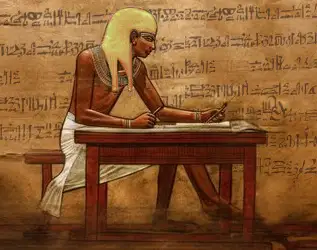
Scribes underwent formal education in specialized schools that focused on teaching reading, writing, mathematics, and other skills necessary for administrative and clerical tasks. The training was rigorous and involved a long period of education, typically starting at a young age. These schools were often associated with temples or administrative centres, where the scribes received training under the guidance of experienced teachers. The ability to read and write hieratic, as well as mastering the complex administrative and legal scripts was crucial for scribes working in civil service offices. Reading and writing hieroglyphs were reserved for religious and monumental inscriptions, while hieratic was used for everyday administrative and literary purposes. Most scribes were only taught hieratic, only the most advanced were also taught hieroglyphs, especially those working in religious or monumental contexts.
Temples were significant centres of education and administration in ancient Egypt. Scribes were closely associated with temple activities, as they played a key role in recording religious rituals, managing temple finances, and maintaining sacred texts. They participated in the production and preservation of religious literature, including hymns, prayers, and magical spells. Writing was almost entirely made on papyrus rolls.
Employed in various governmental offices and administrative centres, they were responsible for maintaining records related to taxation, land ownership, legal matters, and other administrative functions. Scribes were held in high esteem in ancient Egyptian society, and their work was considered prestigious and essential for the functioning of the state and religious institutions. Sons of scribes inherited their fathers’ civic position.
The Egyptians wrote with a brush made from the stem of a rush called Juncus maritimus, which still thrives in Egypt’s saline marshes.
Scribes in the royal courts played essential roles in documenting royal decrees, managing correspondence, and maintaining records of the pharaoh’s activities. The highest-ranking scribes might have had the privilege of serving the pharaoh directly and participating in the administration of the kingdom. While most scribes served in institutional settings, some were employed in private households, especially by individuals who required assistance with correspondence, legal matters, or other administrative tasks. The military also required scribes, where they kept military records, documenting campaigns, and managing logistics.
There were also workshops where copies of texts were produced. These workshops were responsible for creating multiple copies of religious and literary texts, contributing to the dissemination of knowledge. Some larger institutions, such as temple complexes, may have had libraries where scribes could access and study a wide range of texts. To create multiple copies of a text quickly, one scribe would read a text aloud while several junior scribes wrote it down simultaneously.
Looking at the various 'seated scribe' statues at museums you'll notice their intense, alert expressions. This isn't just artistic flair, it symbolises that they were active listeners, and relied upon to materialise the ethereal spoken word onto material papyrus.
Human error in manuscripts
Human error is a significant factor contributing to the potential corruption of hand-written manuscripts. Scribes, who were responsible for copying texts in ancient times, were skilled individuals, but not immune to making mistakes. Some ways in which human error could lead to alterations in manuscripts:
- Copyist Mistakes - Scribes copied texts by hand, a labour-intensive and meticulous process. In the course of copying, they could make errors such as skipping lines, omitting words, or duplicating phrases. These mistakes might be unintentional, but they can introduce variations into different manuscript copies.
- Misinterpretation of Source Material - Scribes might encounter difficulties in understanding the content of the text they were copying, especially if it was written in an unfamiliar language or used archaic expressions. Misinterpretations could lead to the introduction of errors as the scribe attempted to make sense of the original material.
- Homophony and Paronymy - Egyptologists often find mistakes where a scribe wrote a word that sounds like the correct one but has a completely different meaning (homophones) or have similar spellings (paronyms). We know this happened because of errors found in surviving papyri. Scribes may have inadvertently substituted one word for another due to their phonetic or visual resemblance, leading to semantic changes in the text.
- Spelling Variations - There were no standardized spelling rules in many historical periods, and individual scribes might have had their own conventions. Consequently, variations in spelling of words within a single manuscript or across different copies of the same text could result from the scribe's personal preferences or lack of a standardized language.
- Dittography and Haplography - Dittography occurs when a scribe unintentionally repeats a sequence of letters or words. Haplography, on the other hand, is the accidental omission of a repeated letter or word. Both phenomena can alter the intended meaning of a sentence or passage.
- Eyeskip Errors - Scribes could make errors by skipping lines or repeating portions of text due to a momentary lapse of attention or visual oversight. This can lead to the introduction of inaccuracies or omissions in the copied manuscript.
- Tiredness and Fatigue - The process of copying manuscripts was labour-intensive and time-consuming. Scribes, especially those working for extended periods, could experience fatigue, leading to a decline in concentration and an increased likelihood of making errors.
- Scribal Corrections - Scribes sometimes noticed mistakes after completing a portion of the manuscript and attempted to correct them. However, the corrections themselves could introduce new errors or lead to inconsistencies in the text.
- Abbreviation Errors - Scribes often used abbreviations to save time and space. However, misinterpretation or misapplication of these abbreviations could result in errors, especially if there were variations in the conventions used by different scribes or regions.
- Transcription Errors - When later scribes copied existing manuscripts, they might introduce errors while transcribing the text. These errors could compound over successive copies, leading to further corruption.
Understanding the potential for human error is crucial for scholars engaged in textual criticism, a field that aims to reconstruct the most accurate version of a text by comparing different manuscript copies and identifying variations. This process helps researchers discern the original wording and meaning of a text despite the inevitable errors introduced by scribes throughout history.
The codex format refers to a type of book characterized by pages bound together on one side, forming a more book-like structure compared to the scroll. While the widespread adoption of the codex format occurred later, during the late Roman and early Christian periods, its roots can be traced back to antiquity.
It's important to note that the study of ancient manuscripts involves careful consideration of these potential sources of corruption. Scholars and historians use various techniques, such as textual criticism, to identify and correct errors, understand the context, and reconstruct the most accurate version of the original text. The Egyptians wrote with a brush made from the stem of a rush called Juncus maritimus, which still thrives in Egypt's saline marshes.
Copying texts by hand is a labour-intensive and meticulous process. In the course of copying, there are many ways errors could be introduced, such as skipping lines, omitting words, or duplicating phrases. These mistakes, though unintentional, could create variations among different manuscript copies. Scribes might encounter difficulties in understanding the content of the text they were copying, especially if it was written in an unfamiliar language or used archaic expressions. Misinterpretations could lead to the introduction of errors as the scribe attempted to make sense of the original material.
Scribes might inadvertently substitute one word for another due to phonetic or visual similarity, leading to semantic changes in the text. Different schools or individual scribes often had their own conventions, leading to inconsistencies both within a single manuscript and between different copies of the same text. Dittography and Haplography can alter the intended meaning of a sentence or passage.
Skipping lines or repeating portions of text due to a momentary lapse of attention or visual oversight is also possible, leading to the introduction of inaccuracies or omissions in the copy. Fatigue, especially when working for extended periods, could lead to a decline in concentration and an increased likelihood of making errors.
Sometimes mistakes were noticed after completing a portion of the manuscript and attempts to correct them could introduce new errors or lead to inconsistencies in the text. Words were often abbreviated to save time and space. However, misinterpretation or misapplication of these abbreviations could result in errors, especially if there were variations in the conventions used by different scribes or regions.
When later scribes copied existing manuscripts, they might introduce errors while transcribing the text. These errors could compound over successive copies, leading to further corruption.
Understanding the potential for human error is crucial for scholars engaged in textual criticism, a field that aims to reconstruct the most accurate version of a text by comparing different manuscript copies and identifying variations. This process helps researchers discern the original wording and meaning of a text despite the inevitable errors introduced by scribes throughout history. As usual, non-professionals without specialized knowledge can only marvel at the skills of the professionals.
It’s important to note that the study of ancient manuscripts involves careful consideration of these potential sources of corruption. Scholars and historians use various techniques, such as textual criticism, to identify and correct errors, understand the context, and reconstruct the most accurate version of the original text.
The codex format refers to a type of book characterized by pages bound together on one side, forming a more book-like structure compared to the scroll. While the widespread adoption of the codex format occurred later, during the late Roman and early Christian periods, its roots can be traced back to antiquity.
Many documents from the ancient Greek, Ptolemaic and Roman worlds survive only in epitome, the practice of writing condensed versions of larger works. Epitomists may have attempted to preserve the spirit of the original, but as with all secondary sources, a different bias may be introduced, along with the addition of details or anecdotes not present in the original. It also works in the other direction, as important facts may have been changed or omitted, whether by design or error.
Anyone who writes knows that errors are almost inevitable. This is particularly true when copying text; even modern copy-and-paste functions are not immune to introducing errors.