 PHARAOH.SE
Although there is consensus among scholars regarding the fundamental sequence of major chronological periods in ancient Egypt, precise dates and relationships remain a matter of ongoing research and debate.
Introduction
Ancient chronology is reconstructed from evidence that is often preserved in only a single incomplete or fragmentary surviving source. The information available today is all that has survived, making it difficult, if not impossible, to verify the original account. Later copies and historical traditions may also have been modified, expanded or reinterpreted to fit the prevailing narrative. The development of calendars was driven by the need to anticipate the changing of the seasons and the agricultural year. Religious ceremonies, festivals, markets and other events also required a shared understanding of the passage of time.

Astronomy became especially important because the regular movements of the Sun, Moon and stars. Astronomy provided reliable and recurring cycles against which longer periods could be measured. The further back we look, however, the more difficult it becomes to reconstruct a continuous historical chronology. Archaeology can establish the existence, development and relative sequence of settlements, cultures and technologies, but rarely provide a continuous account of events. Written sources can also combine historical events with legend, mythology and later interpretations.
Nevertheless, it is frequently uncertain which type of calendar was employed and whether the presented information is to be regarded as reliable. It is notable that historical dates which have survived were often documented decades or even centuries after the event in question took place. It is similarly conceivable that such sources may have been corrupted, invented, or otherwise altered or added subsequent to the event in question in order to align with a specific narrative.
There was no standard system for numbering years in the ancient world. Different societies used different calendars, eras and methods of recording regnal years, and many dates can only be understood by comparing them with other evidence. Establishing ancient chronology requires the reconstruction of a timeline from multiple sources, including historical records, inscriptions, king lists, astronomical observations, archaeological evidence and synchronisms between independently dated events. Chronology is not based on a single source or method, but on the degree to which different types of evidence can be shown to agree.
The Egyptian calendar
Strangely enough, whether the Egyptian day began at dawn or at sunrise is controversial. The difference affects the Egyptian date assigned to a Heliacal rising of Sothis, and hence the conversion of that date to a Julian year.
The Egyptian civil year consisted of 12 months each with 30 days. To this five extra days were added, making a year 365 days. This was divided into three "seasons" each consisting of four months: Akhet (Inundation or Flood), Peret (Emergence or Growth) andShomu (Harvest or Low Water). However, a solar year is 365.2425 days, which is why we add an extra day every four years. The ancient Egyptians did not do this, so their calendar lost a quarter of a day every year. After a century this would amount to the same date occuring 25 days earlier, which would completely ruin the seasons, a fact well known to the ancients. They probably corrected the calendar informally so that the seasons didn't move too far out of sync with the sun, perhaps at a particular festival. The Islamic calendar is stilllunar, which means that their year is only 354.367 days. This cause its dates to shift almost 11 days each year, making seasons shift from year-to-year.
Dates were usually expressed by the regnal year of a pharaoh, followed by the month, followed by the day, like so: reign of Ramesses II, year 38, III Akhet, day 19. For much of Egyptian history, the months were not referred to by individual names, but were numbered within the three seasons. By the Middle Kingdom, however, each month had its own name that were probably used in daily speech.
| # | Season | Month name | Coptic | Greek |
|---|---|---|---|---|
| 1 | I Akhet | The one of Thōth | Tôut | Thōth |
| 2 | II Akhet | The one of the Opet feast | Baôba | Phaōphí |
| 3 | III Akhet | [The one of] Hathor | Hatûr | Athúr |
| 4 | IV Akhet | The joining of kas | Koiak | Khoiák |
| 5 | I Peret | The offering | Tôbi | Tubí |
| 6 | II Peret | [The one of] the basket? | Meshir | Mekhír |
| 7 | III Peret | The one of Amenhotep | Baramhat | Phamenoth |
| 8 | IV Peret | The one of Renenutet | Barmoda | Pharmouthí |
| 9 | I Shomu | The one of Khonsu | Bashons | Pakhōn |
| 10 | II Shomu | The one of the Valley | Baôni | Pauni |
| 11 | III Shomu | Uncertain meaning | Apip | Epiphi |
| 12 | IV Shomu | The birth of Ra | Masôri | Mesore |
| Day | Name | Meaning |
|---|---|---|
| 1 | The Birthday of Osiris | |
| 2 | The Birthday of Horus | |
| 3 | The Birthday of Set | |
| 4 | The Birthday of Isis | |
| 5 | The Birthday of Nephthys |
To adjust their calendar they used the Sothic cycle as a long-term framework to keep it aligned with the seasons. This cycle was based on the rising of the star Sirius (Greek:
Chronology in the ancient world
The concept of chronology in the ancient world is not as straightforward as it is today, due to the presence of several inherent complications. In order to establish a chronology, a number of different techniques must be employed.
Regnal years
Administrative documents, production dates, and inscriptions were dated by the regnal year: Reign of King Usermaatra, Year 38, III Akhet, day 20. Regnal years were counted from the day of accession of the king, thus not the same as a civil year. Many ancient cultures used regnal year dating because it provided the most immediate and important dates needed. It was not necessary to know when a particular ancestor ruled, especially legendary ones from centuries ago. When one pharaoh succeeded another, the civil year would change in the middle of the year, overlapping the last year of the previous king with the first year of the new ruler, which meant that Year 1 could range from a few days to almost a whole year.
King lists
King lists preserve the sequence of rulers and in some cases the length of their reigns. They are important chronological sources, but should not be regarded as contemporary historical records. Most were compiled centuries after the rulers they name and might incorporate older traditions, omissions, duplications, or legendary material. Documented sequences of kings are very rare, and dated chronological lists even more so, as chronology in the modern sense was unheard of in the ancient world
The Sumerian King List (SKL) is one of the earliest known Mesopotamian examples. It records successive rulers and dynasties of Sumer and Akkad, but its earliest section includes legendary kings with extraordinarily long reigns. It is valuable for the preserved succession and traditions, rather than as an independent chronology. Other Mesopotamian king lists provide more useful chronological connections. The Assyrian King List (AKL) preserves the succession of Assyrian rulers, while the Synchronistic King List (ScKL) places Assyrian and Babylonian rulers in relation to one another. Such synchronisms are particularly valuable because they connect otherwise separate chronological sequences.
King lists provide an essential framework of succession, but they rarely establish an absolute chronology by themselves. Their value increases when their sequences can be connected to contemporary inscriptions, administrative records, astronomical observations, archaeological evidence, or synchronisms with rulers whose dates can be established independently.
In Egypt, the 12th century BC Turin King List, a fragmentary papyrus from the Ramesside period, records the names and reign lengths of more than 200 rulers. It provides an important framework for foundation of Egyptian chronology by establishing the sequence of Egyptian rulers, although gaps and damage to the papyrus mean that it must be supplemented by other evidence. Temple and tomb inscriptions often include the date on which they were made, and the name of the ruling pharaoh. For example, the Battle of Kadesh inscription begins: “Year 5, third month of the harvest season, day 9, under the majesty of Ramesses II ...” Labelled goods (wine jars etc.) often included the date of production in a similar manner.
Kings of Prehistory
Some of the earliest traditions concerning the rulers of Egypt and Mesopotamia extend beyond ordinary human history. Both civilizations preserved traditions in which gods, divine beings, and legendary heroes were said to have ruled before the beginning of ordinary history, sometimes for impossibly long periods.
Both Egypt and Mesopotamia preserve traditions of rulers belonging to a remote age before the historical dynasties. In Egypt, the Turin King List preserves a tradition of divine rulers preceding the human kings, mentioning reigns of thousands of years, including Thoth, for 7 726 years. Manetho, writing in the Ptolemaic period, also placed the gods and demigods before the human dynasties, assigning them extremely long periods of rule.
Egyptian religious texts also preserve traditions concerning the gods as the primordial rulers of Egypt, although these should not be confused with the historical dynastic king lists.
Mesopotamian tradition contains a strikingly similar pattern. The Sumerian King List (SKL) begins with kings who ruled before the Flood, including Alulim of Eridu, whose reign is given as 28 800 years, followed by other rulers whose reigns are similarly extraordinary. After the Flood, the recorded reign lengths gradually become more plausible before eventually reaching historically attested rulers. The transition to historical time is therefore not unique to either civilization.
The impossibly long reigns also illustrate an important principle when evaluating ancient king lists: the presence of a king or dynasty in a chronological tradition does not, by itself, establish that the chronology is historical. The king list must be assessed against contemporary inscriptions, archaeological evidence, synchronisms, astronomical observations, and other independent sources.
These reigns cannot be accepted as literal chronology. However, neither does it necessarily mean that every underlying tradition was invented when it was written down. Some ancient traditions may preserve distorted memories of peoples, rulers or events from much earlier periods that have since disappeared from the archaeological record. Some of the legendary rulers may even have been real historical figures whose names and deeds survived only through oral tradition before eventually being recorded in a much later period.
The possibility becomes particularly difficult to evaluate when considering periods of many thousands of years. Ten thousand years is an immense span of time, during which settlements can be abandoned, destroyed, buried, eroded or otherwise lost. Most materials used in everyday life are unlikely to survive such periods in recognisable form, particularly when exposed to the elements, while even durable remains may remain undiscovered. The archaeological record is therefore necessarily incomplete, and the absence of physical evidence for a particular people or settlement does not by itself demonstrate that it never existed.
This does not mean that the legendary kings belonged to an unknown prehistoric civilisation, but it leaves open the possibility that some traditions may preserve distant and heavily transformed memories of events or people for which no evidence has yet been found. Contemporary archeologists and historians are reluctant (or unwilling) to confirm the possible existence of these legendary rulers, even though it is possible that future discoveries may shed light on their historical basis. Proposals that civilisations existed thousands of years earlier than the conventional historical record are dismissed, often with a smirk, as pseudohistoryile there is currently insufficient evidence to substantiate these claims, they raise questions that deserve to be considered separately from both established history and outright pseudohistory.
Chronology must distinguish between established evidence, historical reconstruction, traditional accounts and speculative hypotheses, while remaining open to the possibility that future discoveries may substantially alter our understanding of humanity's earliest history.
Synchronisms
Ancient cultures used a wide variety of calendars and systems for recording dates. Because each culture had its own system, it can be difficult to convert and synchronise dates between different calendars, particularly as the accuracy of the records was of varying quality where they exist at all. A particularly valuable form of synchronism is diplomatic correspondence between kings, unearthed in the ruins of Akhetaten, buried when the ephemeral capital was abandoned. The correspondence provides the names of rulers from different kingdoms and establishes that they were contemporaries. When one of the rulers can be dated independently, the synchronism allows the chronology of the other kingdom to be anchored to the same period.
While the Sumerian King List is useful for Mesopotamian historiography, it does not provide much chronological context on its own. The Synchronistic King List is more relevant to the interconnection of Mesopotamian chronologies, as Assyrian and Babylonian kings are placed in parallel. However, the surviving text is fragmentary and incomplete. Synchronisms are among the most important tools for connecting otherwise independent chronologies. A single securely dated event or ruler can provide a chronological anchor that allows dates in another historical tradition to be placed within the same framework.
Genealogies
Tombs of high-ranking officials sometimes included records of their ancestry, as well as references to which kings they served under. Administrative documents can provide additional evidence for family relationships, allowing scholars to trace families back several generations. These connections can help corroborate the succession of kings and provide useful chronological controls, particularly reigns that are poorly documented or disputed.
Archaeological records
Archaeology provides an invaluable archive of human history, offering tangible evidence in the form of settlements, structures, artefacts and other cultural remains. Scientific techniques such as radiocarbon dating can help establish when these remains were produced, used or deposited, allowing discoveries to be placed within a broader chronological and historical context.
However, the archaeological record is necessarily limited and incomplete. Most ancient settlements and objects have been destroyed, buried, eroded or otherwise lost, while many surviving remains have yet to be discovered. Materials also survive for very different lengths of time, and the further back we look, the less complete the surviving evidence generally becomes.
Archaeology provides physical evidence of the past, while scientific dating methods and historical interpretation help establish when that evidence belongs. It can provide strong chronological evidence where suitable remains and dating methods are available, but the absence of archaeological evidence for a particular people, settlement or period does not necessarily demonstrate that it never existed.
Traces of human activity are often remarkably short-lived when measured against the vast span of human history. Most buildings, tools and everyday materials do not survive intact for many thousands of years, and settlements can be destroyed, buried or eroded beyond recognition. Consequently, entire periods of human activity may leave little or no identifiable trace in the archaeological record.
Astronomical records
Astronomical observations played an important role in helping to regulate calendars, determine the timing of religious festivals, and predict seasonal changes important to agriculture. Ancient records sometimes describe astronomical events such as solar and lunar eclipses, planetary movements, and the positions of stars.
These observations can provide exceptionally precise chronological evidence. Because the movements of celestial bodies can be calculated using modern astronomical methods, a sufficiently detailed and reliable ancient observation can sometimes be assigned to a specific date in the past. Such observations can therefore provide independent chronological anchors against which historical records and king lists can be compared.
However, astronomical dating also depends on the reliability of the original record. The location from which an observation was made can be particularly important, as the visibility and position of celestial objects vary according to the observer's location. If the location, date, calendar system, or details of the observation are uncertain, several possible dates may result.
The surviving astronomical record is also incomplete. Astronomy can provide remarkably precise dates for particular events, but cannot by itself establish a continuous chronology when no observations survive.
Establishing a chronology
No single source can normally provide a complete and reliable chronology of the ancient world. Instead, chronology is constructed by comparing different types of evidence and looking for points where they overlap. A regnal year may establish when a document was produced within a particular reign; a king list may establish the sequence of rulers; a synchronism may connect two otherwise independent chronologies; and archaeological or astronomical evidence may provide an independent means of dating an event.
The further back in time we go, the fewer independent sources tend to survive, and the greater the uncertainty becomes. Conversely, where several independent sources agree on the same sequence or date, confidence in the resulting chronology increases. Chronological dates should therefore be regarded as conclusions drawn from the available evidence rather than as facts that necessarily appear directly in any single ancient source.
Some periods are particularly well anchored because historical records can be connected to independently datable astronomical events. A prime example is Ptolemy's Canon of Kings, which preserved the astronomical tradition of ancient Near Eastern chronology.
Ptolemy's Canon of Kings
Ptolemy of Alexandria, who flourished under Roman rule in the second century AD, compiled a chronological list of rulers preserved in the astronomical tradition of Claudius Ptolemy. It is likely that this list was based on even older lists and was used by astronomers as a practical manner of dating astronomical events. Known as Ptolemy’s Canon, it has been preserved by multiple succeeding authors, who often supplemented it with up-to-date knowledge from their own times.
Its importance is not simply that it provides a succession of kings. Ptolemy used the regnal years as a chronological framework for astronomical observations recorded in his Almagest. It can be fixed astronomically to 26 February 747 BC in the Julian calendar, the beginning of the first year of Nabonassar according to the Egyptian calendar used by Ptolemy. The Babylonian astronomical tradition provides a very strong connection between historical dates and independently calculable celestial phenomena. Almagest preserves observations of eclipses and planetary positions of specific regnal years. Babylonian astronomical texts provide additional observations and chronological evidence. These sources allow the sequence of Babylonian rulers and their regnal years to be checked against the astronomical calculations.
The Canon is not an isolated king list from which the entire ancient chronology can be derived. The chronological value comes from its integration with dated astronomical observations and other historical evidence. It provides an important chronological framework for the first millennium BC, particularly in connecting Babylonian and Persian history with the subsequent Hellenistic era. Its importance for Egyptian chronology is indirect but substantial. Once the chronology of the Near East is securely anchored, synchronisms between Egyptian and Near East kings can be used to connect Egyptian chronology to this independently established framework.
Historians generally regard the Canon to be accurate, and it forms the foundation of ancient chronology from 747 BC forward, to which all other datings are synchronised.
Ptolemy’s Canon is divided into three sections:
Twenty Babylonian kings (747–539 BC) were followed by ten Persian kings (538–332 BC), who conquered Mesopotamia. Astronomers in Alexandria continued the list, first detailing the Macedonian kings (331–305 BC) and then the Ptolemies of Egypt (304–30 BC).
| Name (in Greek) | Transliteration | Reign | Total | Dates (BC) |
|---|---|---|---|---|
| Babylonian Kings | ||||
| Ναβονασσάρου | Nabonassaros | 14 | 14 | 747–734 |
| Ναδίου | Nadios | 2 | 16 | 733–732 |
| Χινζηρος και Πώρου | Khinzer and Poros | 5 | 21 | 731–727 |
| Ιλουλαίου | Iloulaios | 5 | 26 | 726–722 |
| Μαρδοκεμπάδου | Mardokempados | 12 | 38 | 721–710 |
| Αρκεανου | Sargon II (Arkeanos) | 6 | 43 | 709–704 |
| άβασίλευτου | Without a king | 2 | 45 | 704–703 |
| Βιλίβου | Bilibos | 3 | 48 | 702–700 |
| Απαραναδίου | Aparanadios | 6 | 54 | 699–694 |
| Ρηγεβήλου | Rhegebelos | 1 | 55 | 693 |
| Μεσησιμορδάκου | Mesesimordakos | 4 | 59 | 692–689 |
| άβασίλευτου | Without a king | 8 | 67 | 688–681 |
| Aσαραδινού | Esarhaddon (Asaradinos) | 13 | 80 | 680–668 |
| Σαοσδουχίνου | Saosdouchinos | 20 | 100 | 667–648 |
| Κινηλαδάνου | Kineladanos | 22 | 122 | 647–626 |
| Ναβοττολασσάρου | Nabopolassaros | 21 | 143 | 625–605 |
| Ναβοκολασσάρου | Nabokolassaros (Nebuchadnezzar II) | 43 | 186 | 604–562 |
| Iλλοαρουδάμου | Illoaroudamos | 2 | 188 | 561–560 |
| Νηριγασολασσάρου | Nerigasolassaros | 4 | 192 | 559–556 |
| Ναβοναδίου | Nabonadios | 17 | 209 | 555–539 |
| Persian Kings | ||||
| Κυρου | Kyros (Cyrus the Great) | 9 | 218 | 538–530 |
| Καμβύσου | Kambysos (Cambyses II) | 8 | 226 | 529–522 |
| Δαρείου πρώτου | Dareios the First (Darius the Great) | 36 | 262 | 521–486 |
| Ξερζου | Xerxes (Xerxes I) | 21 | 283 | 485–465 |
| Aρταζερξου πρώτου | Artaxerxes I | 41 | 324 | 464–424 |
| Δαρείου δευτέρου | Dareios (Darius II) | 19 | 343 | 423–405 |
| Αρταξερξου δευτέρου | Artaxerxes II | 46 | 389 | 404–359 |
| Ωχου | Ochos (Artaxerxes III) | 21 | 410 | 358–338 |
| Αρωγού | Arogos (Artaxerxes IV) | 2 | 412 | 337–336 |
| Δαρείου τρίτου | Dareios the Third (Darius III) | 4 | 416 | 335–332 |
| Αλεξάνδρου Μακεδόνος | Alexander the Great | 8 | 424 | 331–324 |
| Macedonian Kings | ||||
| Φιλίππου | Philippos (Philip III Arridaeus) | 7 | 7 | 323–317 |
| Αλεξάνδρου ετερου | The other Alexandros (Alexander IV) | 12 | 19 | 316–305 |
| Πτολεμαίου Λάγου | Ptolemaios Lagos (Ptolemy I Soter) | 20 | 39 | 304–285 |
| Φιλαδελφου | Ptolemy II Philadelphus | 38 | 77 | 284–247 |
| Ευεργέτου | Ptolemy III Euergetes | 25 | 102 | 246–222 |
| Φιλοπάτορος | Ptolemy IV Philopator | 17 | 119 | 221–205 |
| Επιφανούς | Ptolemy V Epiphanes | 24 | 143 | 204–181 |
| Φιλομητορος | Ptolemy VI Philometor | 35 | 178 | 180–146 |
| Ευεργέτου δευτέρου | Ptolemy VIII Euergetes II | 29 | 207 | 145–117 |
| Σωτηρος | Ptolemy IX Soter | 36 | 243 | 116–81 |
| Διονύσου νέου | Ptolemy XII Auletes Dionysos Neos | 29 | 272 | 80–52 |
| Κλεοπάτρας | Kleopatra (Cleopatra VII) | 22 | 294 | 51–30 |
Astronomical Tablet of Nebuchadnezzar II
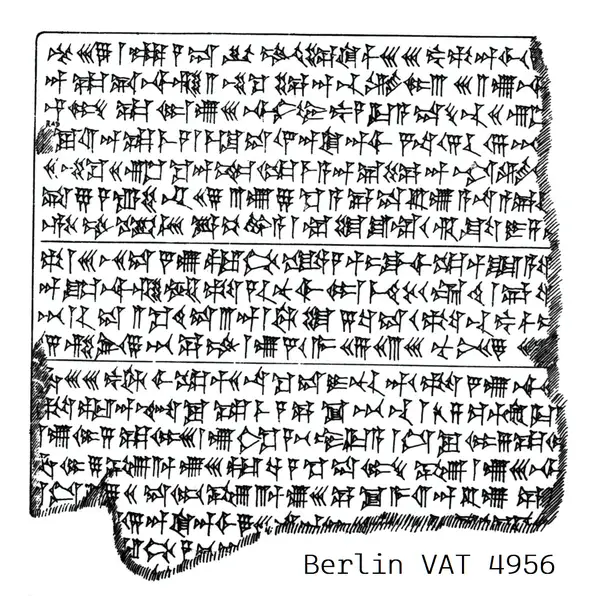
The Astronomical Tablet of Nebuchadnezzar II is a cuneiform tablet that details a series of astronomical observations during the 37th year of the Babylonian king's reign. Modern astronomy shows that the only year that matches the dates within centuries is 567 BC. This would mean that the first year of Nebuchadnezzar's reign was 604 BC, which is perfectly consistent with the canon. There are several biblical references to the reign of Nebuchadnezzar II that provide a link with Hebrew chronology, which together with other contemporary king lists further confirm the validity of Ptolemy's sequence of kings, providing reasonably accurate dates as going back to 747 BC.
The Julian calendar
When administering the rapidly expanding Roman Empire, it became clear that a calendar was needed to coordinate the many local calendars in use. This calendar would be used throughout the Empire. The Romans recognised the Julian calendar's greater accuracy compared to the old Egyptian calendar and adopted it as their primary calendar, which later became the standard for most of the Western world. The Julian calendar added an extra day every four years.
Like the Egyptians, the Romans did not number each year sequentially from a specific year, but instead differentated years by naming the two elected consuls in Rome serving a specific year. For example: in the Year of Braccus and Cassius, the Consuls were Cassius and Braccus, and if Cassius served multiple times, the second time his name would have an additional number, Braccus and Cassius II, the third time, Probus and Cassius III, and so on.
The lists of the elected consuls, the Fasti consulares, were originally engraved on marble tablets erected in the Roman forum, and survive in the writings of several historical accounts, along with fragments from various places throughout the Empire.
In the middle of the first century BC, the Roman scholar Terentius Varro established a system that place the traditional foundation of Rome as year 1 ab urbe condita (A.U.C.). The year of the founding of the Republic was available from the fasti, and Varro simply added seven generations before that, counting each generation as 35 years (7 × 35 = 245).From Cicero we learn that according to the annals of the Greeks, Rome was founded in the second year of the seventh Olympiad.
Eratosthenes of Cyrene established the use of the Olympiad and the individually numbered years between them in the third century BC. Olympic dates survive in Eusebius' Chronicon, which attempted to reconcile the events of biblical history with classical historical material, and was only used for historical purposes, never for everyday use. The second part of Chronicon, the Canons, puts the historical material into a parallel timeline, listing the reigning rulers of each nation side-by-side, for every year. Jerome's Latin translation, written in Constantinople around 380, preserves the chonological tables. The original is lost, but survives in copies made by later writers.
The Anno Domini (AD) was developed by the monk Dionysius Exiguus in 525 AD (A.U.C. 1278), as a result of his work on calculating the date of Easter, but was not widely used until the 9th century. He produced tables with a 19-year cycle for calculating Easter but also years since the birth of Christ, which is the basis of the AD system:
Nineteen year cycle of Dionysius(Cyclus decemnovennalis Dionysii)
First Argumentum. On the years of Christ. If you want to find out which year it is since the incarnation of our Lord Jesus Christ, compute fifteen times 34, yielding 510; to these always add the correction 12, yielding 522; also add the indiction of the year you want, say in the consulship of Probus Junior, a 3, yielding 525 years altogether. These are the years since the incarnation of the Lord.
Consulting Dionysius’ Easter table, which includes years in the era of the Roman emperor Diocletian, we see that Probus was consul in the year 241 of Diocletian. Subtracting 241 from 525 gives 284, the year in which Diocletian became emperor.
Although Moses was a first-hand witness to what he wrote, the Bible is not very helpful as it does not name the Pharaohs in the time of Moses and Joseph. However, a few Late Period pharaohs were named: Shishak (1 Kings 11:40), Tirhakah (2 Kings 19:9), Hophra (Jeremiah 44.30), and Neco (2 Kings 23:29).
Syncronizing events and calendars
So, with that out of the way, how do we go about to establish a chronological link between today and a pharaoh? We could simply look it up in a book on the subject, but that does not actually teach us anything. Instead, we will trace the path and then actually walk that path. It's important to acknowledge the role of Roman influence in the study of ancient chronology, as most surviving texts have passed through a Roman "filter", influencing the development of our understanding of ancient history.
Chronology
- 2026
The current year.
- 1582 444 years ago
The Gregorian calendar adopted. All dates before this use the Julian calendar.
- 643 1383 years ago
Arabic-Greek Papyrus PERF 558 is dated by Islamic (1 Jumada al-Thani 22 AH) and Coptic (30 Baramudah I, 360 AM) dates, corresponding to 25 April 643.
- 525 1501 years ago
Dionysius developed Anno Domini in 525 = A.U.C. 1278 = 241 Anno Martyrum.
- 284 1742 years ago
The Alexandrian calendar used by the Coptic church start in 284 AD, and is year 1 Anno Martyrum – the year Diocletian became Roman Emperor.
- 27 BC 2054 years ago
Octavian becomes Augustus, the first Roman emperor.
- 30 BC 2057 years ago
The last pharaoh of Egypt, Cleopatra, is defeated by Octavian and commits suicide.
- 509 BC 2536 years ago
Rome becomes a republic = A.U.C. 245.
- 747 BC 2774 years ago
The first Babylonian king Nabonassaros of Ptolemy's Canon of Kings started his reign 696 years before Cleopatra started hers.
- 753 BC 2780 years ago
The traditional foundation of Rome = A.U.C. 1.
- 763 BC 2790 years ago
June 15 solar eclipse in Sicily is used to fix the chronology of the Ancient Near East. (Diod. 20.5.5)
- 776 BC 2803 years ago
First Olympiad.
Chronology becomes increasingly unreliable the further back in time you go, as records become scarce or sketchy. This is not to say that it is impossible – historians are some very clever people and they have managed to find very elusive evidence to form a coherent and working chronology for very ancient times. However, it is not always possible or necessary to establish exact dates.
Cleopatra, the last of the Pharaohs
We know from Plutarch that during Octavian's fifth consulship, which he shared with Antony, Octavian defeated Cleopatra and Antony in Egypt. This was before he was given the title Augustus, which is clear as he was still known simply as (Imperator) Caesar.
The Fasti Capitolini have a gap for the years around the fifth consulship, but the The Chronograph of 354 records it in AUC 725, but with Appuleius, as do the Fasti of Hydatius, but with Pulchro (alt. Appuleius). This is typical of antiquity - conflicting and/or incomplete information.
The Chronicon Paschale tells us that Augustus (Octavian) landed in Egypt AUC 727 (Anno Mundi 5477) and halted the reign of the Ptolemies, which had lasted 296 years, which according to Ptolemy's Canon of Kings lasted 294 years.
As we have learned above, AUC 1278 = 525 AD. There are 553 years between AUC 725 and AUC 1278. Subtracting 525 AD from those 553 years yield -28. Since there was no year zero, we have to increase it by one, and thus we arrive at -29 = 29 BC ≈ 30 BC, the date commonly used by historians.
All Roman dates, if they are complete and reliable, can be directly expressed in Julian years. All the other datings of ancient chronology are linked to our reckoning by direct or indirect synchronisms with Roman dates.