 PHARAOH.SE
Before the hieroglyphs were understood, the strange animal-headed gods depicted alongside the mysterious hieroglyphs were thought to be divine messages or magical formulas, rather than the language of a vanished civilization.

The language of ancient Egypt spoken by the pharaohs of ancient Egypt is simply referred to as “Ancient Egyptian.” The language has been extinct for 1 500 years and is no longer used for everyday communication. The last vestiges of the language have been preserved in Coptic, but this too has not been spoken for centuries. It's worth noting that virtually all transliterations are just approximations, since Egyptian is an extinct language. Furthermore, the transliterations and spellings of words in French, English, German and Spanish can differ considerably. Spellings may also vary depending on the author. The modern inhabitants of the Nile Valley use Arabic, a completely different language.
The Egyptians themselves called the hieroglyphs 
As can be expected, information about the Egyptian language comes from authors in antiquity who were not native speakers. They were historians, not linguists, and their accounts are often brief and incomplete. They were also writing at a time when the Egyptian language was already in decline, and knowledge of it was limited to a small group of priests and scribes. The accounts are not always reliable, but they do provide valuable insights into the Egyptian language and scripts while they were still in use. In the fifth century BC, Herodotus wrote that:
“The Greeks write and calculate from left to right; the Egyptians do the opposite; yet they say that their way of writing is towards the right, and the Greek way towards the left. They [the Egyptians] use two kinds of writing; one is called sacred (He did not explain the relationship between the different Egyptian scripts we would later distinguish as hieroglyphic, hieratic and Demotic. Four centuries later, Diodorus wroteἱρὰ , hira), the other common (δημοτικὰ , demotika)”Histories 2.36
“In the education of their sons the priests teach them two kinds of writing, that which is called sacred (ἱερὰ , hiera) and that which is used in the more common (κοινοτέραν , koinoteran) instruction.”Bibliotheka 1.81
“... for of the two kinds of writing which the Egyptians have, that which is known as popular (δημώδη , demodi) is learned by everyone, while that which is called sacred (ἱερὰ , hiera) is understood only by the priests of the Egyptians, who learn it from their fathers as one of the things which are not divulged.”Bibliotheka 3.1.5
These accounts reveal a striking mismatch between the terminology used by Greek authors and modern Egyptologists. The reasons for this mismatch are unclear and may simply be differences in terminology, or the Greek authors’ understanding of Egyptian scribal practice.
We must now speak about the Ethiopiansic writing which is called hieroglyphic among the Egyptians, in order that we may omit nothing in our discussion of their antiquities. Now it is found that the forms of their letters take the shape of animals of every kind, and of the members of the human body, and of implements and especially carpenters' tools; for their writing does not express the intended concept by means of syllables joined one to another, but by means of the significance of the objects which have been copied and by its figurative meaning which has been impressed upon the memory by practice.Bibliotheka 3.4.1
In the late second century AD, Clement of Alexandria provided the earliest surviving explicit breakdown of Egyptian scripts. Writing at a time when traditional Egyptian scripts were nearing the end of their functional lifespans, Clement provided the first recorded use of the term hieratic (
Now those instructed among the Egyptians learned first of all that style of the Egyptian letters which is called Epistolographic; and second, the Hieratic, which the sacred scribes practise; and finally, and last of all, the Hieroglyphic, of which one kind which is by the first elements is literal (Kyriologic), and the other Symbolic. Of the Symbolic, one kind speaks literally by imitation, and another writes as it were figuratively; and another is quite allegorical, using certain enigmas.Stromata 5.4
Herodotus's distinction between sacred and common writing, through Diodorus's references to sacred and popular writing, to Clement's explicit classification of epistolographic, hieratic, and hieroglyphic writing do not correspond neatly to the distinctions made by modern Egyptologists, but they show how Greek authors gradually developed their own terminology for describing the different forms of Egyptian writing.
By the middle of the fifth century, the last vestiges of knowledge were collected in Horapollo's Hieroglyphica, as the knowledge of Egyptian writing was approaching extinction. The last known hieroglyphic inscription dates to 394 AD, and the last Demotic (grafitto) to 452 AD, both coincidentally at the Temple of Isis at Philae. When Hieroglyphica was compiled, the Egyptian language and its scripts had ceased to be understood as they were already largely detached from the linguistic system in which they had been written. Within a few generations, the ability to read hieroglyphic, hieratic, and Demotic writing had effectively disappeared.
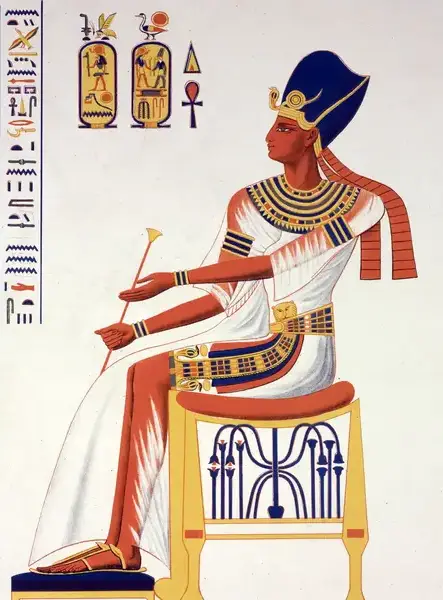
The monuments themselves, however, did not disappear. Temples, tombs, statues, papyri, and inscriptions remained scattered throughout Egypt, and some Egyptian monuments had even been transported to Europe by the Romans. The obelisks erected in Rome were among the most prominent examples, where they could be seen and admired for centuries despite the loss of the knowledge needed to read their inscriptions. Following the Arab conquest of Egypt in the seventh century, Arabic gradually replaced Coptic as the dominant language of Egypt. Coptic, the final stage of the ancient Egyptian language, survived for centuries, but its decline eventually severed the last connection between the spoken language of Egypt and the ancient inscriptions. The knowledge of hieroglyphic, hieratic, and Demotic writing had already been lost, and with the decline of Coptic there was no longer a living Egyptian linguistic tradition through which the ancient texts could readily be understood.
For centuries, European scholars only had limited access to Egyptian monuments and little means of understanding them within their original historical context. European knowledge of ancient Egypt had to rely on very old descriptions from the Bible, classical authors, surviving monuments, and the scarce accounts of travellers. In the early 18th century, European travellers and clergymen began to visit Egypt, and returned with stories of vast ruins and massive monuments. It should be pointed out that the rudimentary maps of Egypt available at the time were from antiquity and about 1500 years old. As can be expected, the maps were inaccurate and incomplete, and even location of the ancient capital of Thebes, was misidentified time and again.
Scholars who took an interest in hieroglyphs generally regarded them as a system of symbolic or ideographic signs, rather than as a script capable of recording ordinary language. Influenced particularly by Horapollo, they believed that the signs concealed profound religious, philosophical, and esoteric meanings. This made the idea of deciphering hieroglyphs difficult to conceive, because if signs represented ideas rather than a sound or word, there was likely no underlying language to recover. This tradition reached one of its most elaborate forms in the work of the German Jesuit scholar Athanasius Kircher in the seventeenth century. Kircher made extensive attempts to interpret Egyptian hieroglyphs, but he did not decipher them in the modern sense. Assuming that the signs encoded layers of symbolic, theological and philosophical meaning, he made allegorical rather than linguistic translations. Kircher's interpretations were incorrect, but his work was significant. It brought the study of hieroglyphs into European scholarship and demonstrated that the inscriptions could, in principle, be understood.
![Mémoires pour l'histoire des sciences & des beaux-arts (1704), plate 1 [https://gallica.bnf.fr/ark:/12148/bpt6k30636]](/images/1704hieratic.webp)
However, for centuries hieroglyphs were understood very differently. Following the interpretations of the ancient Greeks and later Horapollo, they became regarded as a mystical symbols concealing religious, philosophical, and secret knowledge. This fundamentally misunderstands their nature. Hieroglyphic writing is not an occult or esoteric system, but simply a writing system used to record the ancient Egyptian language. Which is why it is imperative to learn the Egyptian language itself, to be able to understand what the hieroglyphs say. The same goes for hieratic and Demotic, of course.
The Napoleonic Expedition (1798–1801) dramatically increased the availability, accuracy, documentation, and accessibility of Egyptian antiquities and providing European scholars with an unprecedented body of material to study. The expedition’s scientists documented a staggering volume of inscriptions, copying temple walls and collecting artifacts that had remained obscured for millennias. This was the first time the monumental scale of Egyptian architecture was revealed to the West. It became clear that the pyramids were not merely isolated curiosities, but part of a sophisticated landscape of temples whose grandeur and complexity were unlike anything else in the world.
Egyptology as we know it today was still not born, so most of the depictions of the scripts were rudimentary and often incorrectly copied. The findings were published in the following decades as part of Description de l’Égypte. It was the catalyst for Egyptomania, which swept across Europe, igniting the world's fascination with Egypt. This fascination was responsible for the subsequent decades of adventurers looting of monuments and the stealing of artifacts, but ultimately also for the establishing of Egyptology as a field of study.
Deciphering the hieroglyphs
When the Rosetta Stone was uncovered in Egypt in 1799, it looked like decipherment was only a few steps away, as it contained a trilingual text in hieroglyphs, Greek and a mysterious third unidentified script. Scholars were groping in the dark at the time, unaware that the texts of this unidentified script available to them in fact contained texts of two similar-looking but distinct scripts. Efforts to decipher this mysterious script alongside the hieroglyphs was hampered by not knowing this important fact. Furthermore, it was assumed that the unidentified script worked non-phonetically like the hieroglyphs. Since the Greek was readable, scholars could compare the texts directly. Researchers were forced to rely on transcriptions of the ancient scripts that were of an extremely poor quality. Indeed, the majority of reproductions were not accurate representations of the original texts.
Several researchers contributed to the consolidation of information about the ancient Egyptian language and associated scripts throughout the course of the following 25 years. As noted above, according to the historians of antiquity there were two Egyptian scripts, hieratic and Demotic. Scholars slowly made progress on the unknown script of the Rosetta Stone, identifying some recurring patterns and tenatively identifying some proper names. It was suggested that some of the signs could be phonetic, but no useable system way was found. Thanks to the Rosetta Stone, it was slowly realised that some signs of the mysterious script did correspond to hieroglyphic values, which was a major step toward cracking the whole system. Against all odds, some hieroglyphs were eventually found to be phonetic by comparing them with readily translatable Greek words and applying knowledge of Coptic.
In 1821, the French scholar Jean-François Champollion had an epiphany. Recognizing that certain cursive marks on papyri were systematically related to hieroglyphs was a major intellectual leap. He noticed that the mysterious Rosetta script was similar, but not identical. After extensive research he proved that it had to be hieratic, and the text on the Rosetta Stone is indeed Demotic. Champollion's breakthrough came from a deeply philological and historical approach. He traced the evolutionary relationship between the three scripts, arguing they were not separate inventions but successive simplifications of a single language: Hieroglyphs → hieratic → Demotic → Coptic.
Central to Champollion's breakthrough was his mastery of Coptic. He had studied it since childhood and had become fluent in what is the final stage of the Egyptian language, written using a Greek-derived alphabet. He realised that if Demotic is a simplified version of Hieroglyphs and Demotic uses the Egyptian language, and Coptic is a later version of the same language, then the sounds and words of Coptic are the sounds and words hiding inside the hieroglyphs. This discovery was a very important step in solving the mystery of hieroglyphs, as hieratic papyri would provide a secondary source for many texts from Egypt.
Champollion published his Summary of the hieroglyphic system in 1824 providing the key to reading hieroglyphs, and establishing beyond doubt that the hieroglyphs themselves were composed of both phonetic and ideographic elements. Over the next few decades scholars verified and improved on Champollion's system, finally revealing the exact nature of the hieroglyphs. The next generation of explorers and scholars understood and embraced the importance of accurately reproducing the ancient texts.
Egyptian hieroglyphs consist of three types of glyphs:
- Phonetic – including alphabetic characters.
- Logographic – representing a word, or part of a word; like how the % sign equals the word percent.
- Determinative – placed at the end of phonetic or logographic words, narrowing down the meaning.
The titulary of the pharaohs were almost never reused, but created specifically for each king upon ascension.
The Egyptian scripts
Ancient Egyptian was based on an alphabet of 24 consonants, not all of which correspond to European alphabets. As in Arabic and Hebrew, the vowels were not written but had to be provided by the reader or speaker. However, there are a number of indications regarding the vowel sounds in Coptic, which is a late form of the Egyptian language that has survived to the present day. When transcribing Egyptian words, the general rule used by Egyptologists was that if there were clues in Coptic, use them, otherwise add an ‘e’ to the words until you get something pronounceable to European ears. The transcriptions were made mostly by English, French and German Egyptologists using their own language, resulting in wide variations of the names of the pharaohs.
Scribes were highly educated individuals who were responsible for record-keeping, drafting legal documents, and maintaining religious texts. For the majority of Egypt's history, three distinct scripts were in use. The most common was hieratic, used for everyday transactions like inventory, wages and tax records. Artisans also used hieratic to mark their finished products. Cursive Hieroglyphs were reserved for religious texts, while Hieroglyphs were used for inscriptions on monuments erected in honour of kings and other prominent figures. Hieratic writing was mostly done in ink on papyrus, while hieroglyphs were carved onto more durable materials such as stone, metal, wood, and so on. It might be prudent to point out the fact that the literacy rate in ancient Egypt was very low (estiamated at 1-2%), and limited to the small elite of scribes. Most people depended on talking and using symbols to share information.
The art style of Ancient Egypt is very distinctive, always depicting humans in profile, except for the torso, which is seen from the front. This art was almost always accompanied by smaller symbols of animals, tools, plants and more. However, these were not just symbols, but a highly formalized script and language: the hieroglyphs.
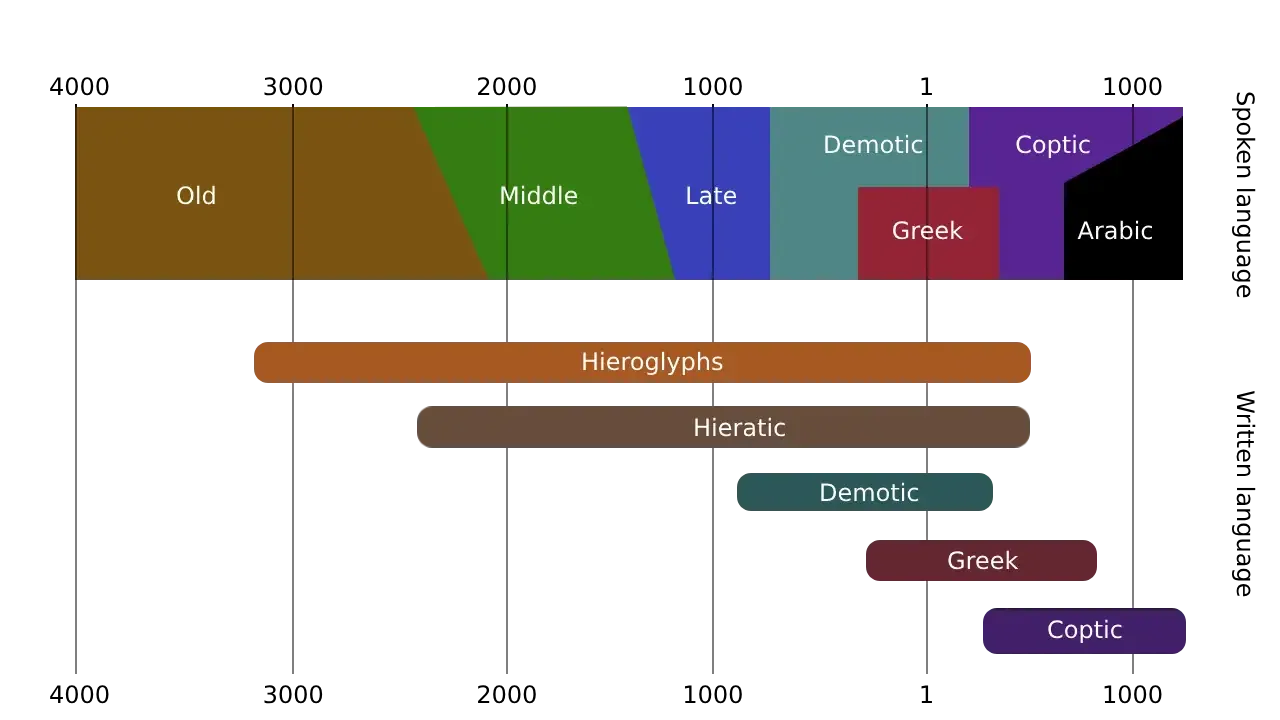
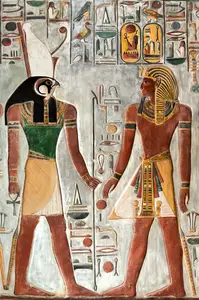 Thanks to a large collection of preserved writings, the deciphering of the hieroglyphs in the early 19th century revealed that the mysterious hieroglyphs were actually an extinct language. The Ancient Egyptian language went through several stages of development known as Old Egyptian, Middle Egyptian, Late Egyptian, and Demotic. These stages correspond to different historical periods.
The ancient Egyptian hieroglyphs were primarily used for monumental purposes, carved in stone, and often very ornate and painted in vivid colors. This was not at all suited for everyday purposes as it often required artistic skills and production was both cumbersome and time-consuming.
The texts can be divided into two stages: Earlier Egyptian, basically all written texts from before 1400 BC, and Later Egyptian, i.e. all later texts, including most surviving papyri. Earlier Egyptian can be subdivided into Old and Middle Egyptian, while Later Egyptian can be subdivided into Late Egyptian, Demotic and ultimately Coptic.
Writing on stone is unforgiving of mistakes and time-consuming in the long run, and a growing government was demanding something a lot easier and faster. The papyrus plant was abundant in the Nile delta, and already used to make baskets, rope and much more. The idea of using papyrus as a writing medium was nothing short of revolutionary. A system was soon devised, using a reed brush dipped in ink to write hieroglyphs on the papyrus. Writing elaborate hieroglyphs in ink is very impractical, and a simplified script that retained the form of the hieroglyphs, but was easier and faster to write soon emerged: Cursive Hieroglyphs. But even this was still slow, and not suited for everyday administrative purposes, so an even faster and more simplified system came into being: Hieratic.
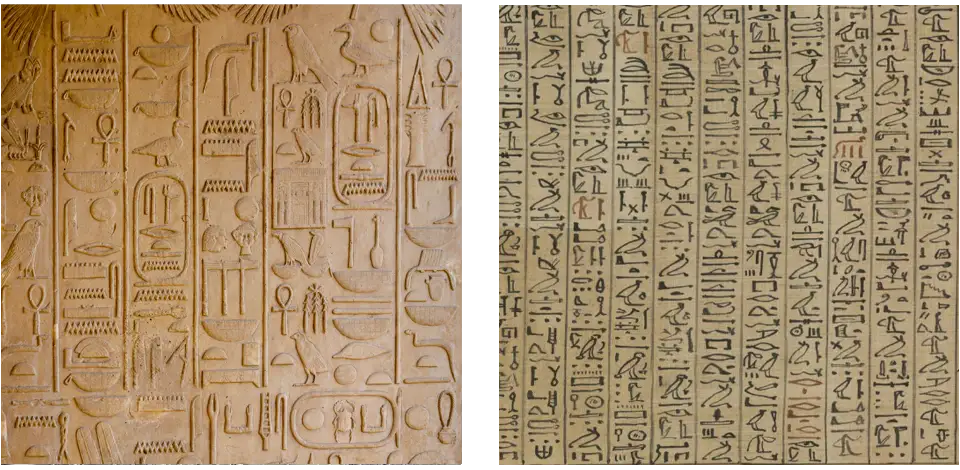
As papyrus and ink were much better suited to the increasing daily volume of documents required by the administration of the kingdom, hieratic writing was undoubtedly one of the most important developments in ancient Egypt. Cursive hieroglyphs continued to be used, but mainly for important religious texts such as the Book of the Dead.
Hieratic was written horizontally, from the right side to the left. Hieroglyphs could be written vertically, facing left or right, or horizontally, from left to right, or from right to left. Hieratic continued to be used throughout Egyptian history, but by the seventh century BC, changes to the Egyptian language demanded and required a script with standardized sign groups, which turned into Demotic. Both were used, Hieratic for religious purposes and Demotic for everyday use, such as letters, legal papers, and invoices.
Throughout the long history of Egypt natural variations appeared in the hieratic signs themselves, but they were still similar and understandable. As time went on, hieratic came to feature more and more insignificant flourishes and ornamental parts used only to fill empty spaces.
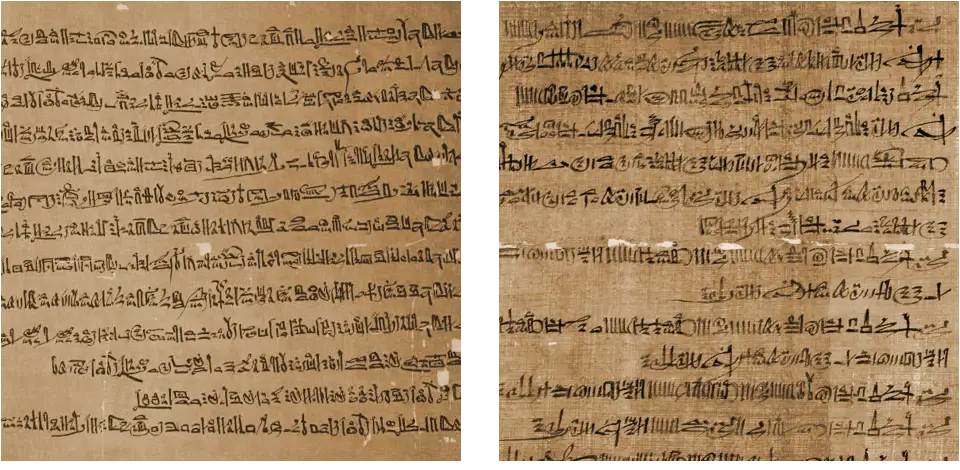
Later dynasties revered the language of the Old Kingdom and strived to imitate the monumental texts, resulting in a highly formalized archaic language that saw very little change throughout Egyptian history. After the conquest by Alexander the Great, hieratic and Demotic were slowly supplanted by transcriptions of Greek characters incorporating Demotic signs for Egyptian phonemes. This final version of the Egyptian language is known as Coptic. The Coptic alphabet (
Hieroglyphs
In transcription, (a written representation of a spoken language) a, i, and u all represent consonants; for example, the name Ramesses was written in Egyptian as Ra-msi-sw. As a matter of convenience, experts have assigned generic sounds to a, i, and u, which is an artificial pronunciation that should not be confused with how Egyptian was actually pronounced at the time. As the hieroglyphs contain no vowels (as such), an "e" is generally inserted between the consonants to form readable words.
Direct translation of hieroglyphs is not possible; first, they must be converted into alphabetic writing, a process known as transliteration, which employs letters not typically found on keyboards:
In the 1980s, the standardised Manuel de Codage system was developed to make writing easier by transliterating hieroglyphics on computers. It substitutes the uncommon characters with standard alphabetic characters.
| Transliteration | |||||||||
| Manuel de Codage | A | a | H | x | X | S | q | T | D |
Gardiner’s Sign List is a comprehensive list of 763 commonly used hieroglyphic signs ordered into 26 categories for occupations, birds, mammals, trees, furniture etc. It was initially compiled by renowned Egyptologist Sir Alan Gardiner in 1927, and is still in use today. Manuel de Codage incorporate Gardiner’s list to reference specific hieroglyphs.
The hieroglyph for the sun, (Ra) is designated as N5, part of Gardiner category N which relates to the sky, earth and water.
Hieroglyphs, unlike alphabetic scripts, can be placed above each other, or form groups of signs called ligatures. They can be written from left to right, or right to left, or even vertically from the top. The reading direction always follow the direction the signs are facing, left or right. Manuel de Codage also incorporates features to change size, orientation, colour and placement of signs. This is necessary to be able to place the signs exactly in their correct position in relation to each other.
To translate hieroglyphs there are a couple steps to go through. Consider these hieroglyphs:
Firstly we need to separate each of the 13 signs, then we can begin the translation process:
Hieroglyphs → 
Transliteration →
Transcription → netjer-nefer za-Ra imn-Htp ankh wedja seneb
Translation → The Good God, Son of Ra, Amenhotep, Life, Prosperity and Health
As Manuel de Codage includes options to add cartouches, grouped signs, 2-dimensional positioning of signs, and much more, the encoded text above becomes:
Manuel de Codage → nTr-nfr-zA&ra-<-i-mn:n-Htp:t*p->-anx-DA-s
Gardiner numbers → R8-F35-G39&N5-<-M17-Y5:N35-R4:X1*Q3->-S34-U28-S29
Amenhotep is transliterated
Software
I recommend JSesh Hieroglyphic Editor by Serge Rosmorduc, which, in my opinion, is the best editor to use for hieroglyphic texts of any kind, and it is not very hard to learn to use. It is available for Windows, Mac and Linux and is completely free! You can even copy and paste the hieroglyphs straight into your Word documents, or, export them as JPG, PNG or SVG files or many other formats.
Manuel de Codage
The first printed version of MdC was published in 1988, basically the Stone Age of computing. A slightly altered version was published online in 1997 at Utrecht University Centre of Computer-aided Egyptological Research (CCER), a project which no longer exists, though the Internet Archive have snapshots of the page from 2001 here. A copy of the page can be found here, and if that vanishes too, it is archived here.
Manuel de Codage is far from perfect however, there are a number of minor annoyances that has been rectified in an updated specification called the Revised Encoding Scheme for hieroglyphic (RES) which has been under (stalled?) development since 2002, but I have found no indication that it has been accepted as the "new" standard. The documentation can be found at The RES-project. There have been several projects over the year, but sadly it always lead nowhere.
Unicode Hieroglyphs
Egyptian hieroglyphs, for example 𓍹𓇳 𓆣 𓂓 𓍺, were added to the Unicode Standard in 2009 and expanded in 2024. However, the signs are displayed sequentially and do not allow for the positioning of individual characters. Although Unicode 17 introduced formatting controls that enable positioning, the process is still in that awkward “technically possible but practically painful” stage. More than 5 000 signs have been encoded and made available for use.
| Name | Signs |
|---|---|
| Egyptian Hieroglyphs | 1 072 |
| Egyptian Hieroglyph Format Controls | 38 |
| Hieroglyphs Extended-A | 3 995 |
| TOTAL | 5 105 |
A database of hieroglyphs called Unikemet (Technical Reports #57, or TR57) lays out a hierarchical classification system for hieroglyphs in 3 levels. Its primary purpose is to act as a machine-readable relational database to make thousands of hieroglyphs actually functional in modern software, search engines, and fonts.
The first core block of Unicode hieroglyphs (U+13000 to U+1342F) mostly uses standard Gardiner-based character names (e.g., EGYPTIAN HIEROGLYPH A001). As Unicode added Extended-A block with almost 4 000 additional signs, naming them individually in English became impossible. Instead, Unicode gave them purely algorithmic hexadecimal names (e.g., EGYPTIAN HIEROGLYPH-138C8).
Instead of making a new classification system, TR57 harmonizes major Egyptological taxonomies into a unified property mapping. For any given Unicode character, it maps the nuances of ancient Egyptian epigraphy and modern Egyptological catalogs by Gardiner equivalents, IFAO catalog codes and JSesh / Hieroglyphica codes. To a computer or a researcher, those names provide zero information. This means text-processing software can instantly recognize that a specific hex code point matches a specific sign from a traditional printed sign-list. TR57 is a specification for the data file unikemet.txt. It is a simple tab-separated metadata that databases, font renderers, and search scripts can parse. For example, it defines whether a character is a logogram, a phonogram or a determinative.
I still have not managed to make the formatting controls work.
Epigraphic conventions
For some reason, the following information was difficult to find in academic reference works on hieroglyphs. Instead, it is assumed that you already know it. As a layman, what would you call it or what would you search for? I had a tough time nailing it down. It turns out that it is epigraphic conventions, or to be exact: early Egyptological epigraphic conventions.
Scribes used black ink on papyrus, with certain (important) signs written in red ink. When Egyptology was still young (i.e. in the 1800s), books and journals were almost universally printed in black and white, and the early Egyptologists often wrote journals by hand. To differentiate red signs, they came up with an elegant solution: by simply underlining them. They quickly realized that dealing with crumbling monuments or papyri, exact annotation is crucial to preserve the text to minimize any ambiguity. They developed the shorthand system described below to record exactly what was on the monument without lengthy descriptions. This is extremely important since numerous hieroglyphic texts suffered damage or were lost following their discovery, making older handwritten publications crucial to preserving the content.
The special brackets described below were used for copying and transcribing hieroglyphs. This allows us to notice the nuances in texts copied by early pioneers, especially since their work preserves texts that have deteriorated beyond readability or been lost entirely. It is apparently called the Leiden Conventions or Leiden bracket system.


Furthermore, when comparing two similar texts, the scholars used horizontal arrows pointing left and right ←→ in place of hieroglyphs indicate that the missing signs were intentionally omitted.
Learn to read & write hieroglyphs
Manley’s Egyptian Hieroglyphs for Complete Beginners is an excellent place to start to learn to read hieroglyphs. It will give you a peek into hieroglyphics, to see if learning to read hieroglyphs is something you really want to do. It will require a lot of time, effort and patience. The books are listed in order of difficulty, each step becoming more difficult, but also more detailed and illuminating. The last two volumes are purely academic work, and require a good understanding of hieroglyphics.
- Bill Manley. Egyptian Hieroglyphs for Complete Beginners.2012.
- Mark Collier and Bill Manley. How to Read Egyptian Hieroglyphs: A Step-by-Step Guide to Teach Yourself. 1998.
- Janice Kimrin. Ancient Egyptian Hieroglyphs : A Practical Guide. 2004.
- James P. Allen. Middle Egyptian An Introduction to the Language and Culture of Hieroglyphs. 2010.
- James A. Hoch. Middle Egyptian Grammar. 1997.
Egyptian Hieroglyphs and Bibliotheca Alexandrina has series of lessons on reading hieroglyphs.
Although updates are infrequent,
the Egyptologists’ Electronic Forum (EEF)
is a treasure trove of Egyptological information.